Showing posts with label Jesus. Show all posts

Saturday, July 18, 2015

Let's Be Disney Protagonists

    "Drive them from our shore!
    They're not like you and me,
    which means they must be evil!
    Let us sound the drums of war!
    They're savages! Savages!
    Barely even human!"
    -"Savages," Pocahontas

    This summer I've been re-watching my favorite Disney (mostly princess) movies. While every story is rich to me (magic, abuse survivors in Snow White and Cinderella, classism in Sleepy Beauty, cute animals!), many movies seems to have a theme of "otherness."
    See, most Disney heroes and heroines don't fit in:
    Aladdin is a street urchin who affirms his worth despite his poverty,
    Jasmine, Mulan, Merida, and Meg don't want to be playthings for men,
    Cinderella and Snow White are abused,
    Aurora, Phillip, and Hercules scorn riches and fame for the people they love,
    Ariel ignores her father's racism for Eric,
    Tiana is a working woman,
    Belle doesn't care to fit in, and, moreover, has compassion on the self-destructive,
    Esmeralda and Pocahontas belong to persecuted peoples,
    Tarzan is actually a different species from his family,
    Simba is haunted by his traumatic past, and
    Anna, Elsa, Quasimodo, and Rapunzel have been kept hidden from the world since childhood.
 
    Yet it's these Others who destroy their worlds' views of class, race, abuse, and goodness.
    Disney movies tell us that what is in our hearts matters more than our differences.
    Yes, even the older Disney stories. The wealthy stepsisters in Cinderella, and the beautiful queen in Snow White, lose because they have no kindness or compassion. In a sense, these princesses are saved by their own kindness and good-hearts - not their looks.
    And yet, how often do we forget this? Really, it's like us adults who grew up on a diet of Disney have forgotten this important lesson.
    Look at the oppression of black males in American society. Look at Franklin Graham's call to stop Muslim immigration, or Charisma News' obsession with the "threat" posed by Muslims and LGBTQ+ people. In fact, look up the statistics on LGBTQ+ homelessness and suicide rates. Try to pretend our society hasn't become like the bigoted Englishmen who belt out "Savages."
    Also, try to pretend the lyrics to "Kill the Beast" aren't very applicable to modern America.

    "We don't like what we don't
    Understand, and in fact it scares us,
    And this monster is mysterious at least.
    Bring your guns, bring your knives,
    Save your children and your wives!
    Save your village and our lives!
    Let's kill the beast!"
    - "Kill the Beast," Beauty and the Beast
   
    Because not only does this song emphasize our tendency to ostracize anything outside the norm, it also shows us what that norm is: trigger-happy manhood. The "we" doesn't include females (or anyone gender-nonconforming), yet, ironically, the heroine Belle is the only one who actually does understand. This idea is also explored in Mulan's  epic "I'll Make a Man Out of You," in which the best "man" turns out to be the woman warrior Mulan.  
    Moreover, last week I re-watched The Hunchback of Notre Dame. I was struck by how much Claude Frollo's persecution of the Romani in the name of purity reminded me of the way my evangelical tradition often treats LGBTQ+ people.
    Yet.
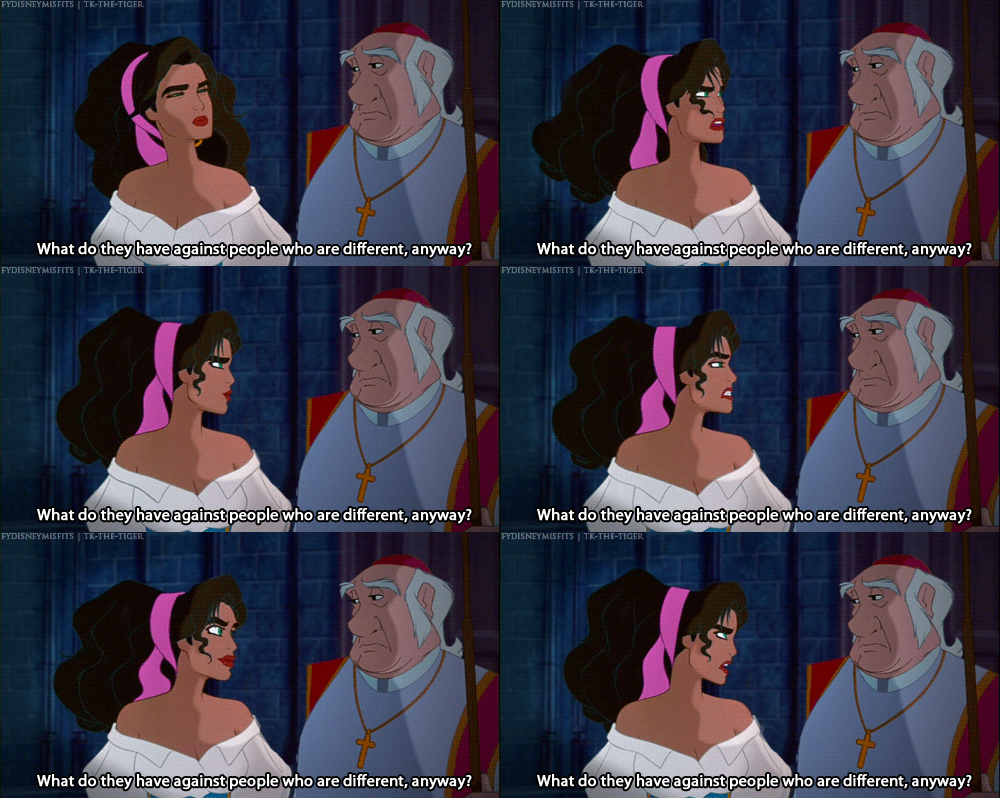
    In one particularly powerful moment, Frollo commands Esmeralda to be silent after she shows kindness to the bullied Quasimodo.
    "Justice!" she shouts back.
    Perhaps, we should all take a cue from Esmeralda. Perhaps, my fellow Christians should show kindness to the LGBTQ+ individuals instead of seeing them merely as sinners. Perhaps - especially to my fellow white American Christians - we should all support the Esmeraldas, the voices of the marginalized (religious, racial, sexual, gender, etc.) crying out for justice.
    "You speak of justice, yet you are cruel to those most in need of your help!" Esmeralda tells Frollo.  
    Perhaps we should not be the puritanical Frollo - or Pocahontas' racist Radcliffe or Beauty and the Beast's chauvinistic Gaston - silencing all who are different than the majority.
    Perhaps we should all endeavor to be like Disney protagonists once again. We should endeavor to see the inside of people different from us, to encourage the good, to subvert the system for love.
    This is what Disney taught me, and what I still faithfully cling to. This is the way of Jesus, who dined with tax collectors and prostitutes.
    This might be idealistic, but it is good.

    "God help the outcasts
    Hungry from birth.
    Show them the mercy
    They don't find on earth...
 
    God help the outcasts
    We look to You still.
    God help the outcasts,
    Or nobody will...

    God help the outcasts,
    Poor and down trod.
    I thought we all were
    Children of God."
    -Esmeralda, The Hunchback of Notre Dame

Love,
Kelley

Wednesday, April 29, 2015

Does Christianity Make You Happy?

    Recently a friend asked me this very question: does Christianity make you happy and give you peace?
    I was taken aback by the fact that I've never heard this question before. You'd think if you followed a religion you'd want to consider if it makes you happy. But I haven't.
    Why? Well, I guess I've always equated happiness with frivolity and selfishness. After all, happiness doesn't necessarily equal good - for example, getting drunk would make me happy, but I wouldn't consider it good. And Jesus did imply that following him equaled suffering. So I'd long dismissed my happiness as unnecessary, something secular people chased after, but not us Christians who knew better (I know, how condescending - I'm sorry). But as A True Christian, I had joy, which was somehow deeper and more fulfilling than happiness.
    Except I've never actually had joy - well, not for long. People say it's a fruit of the spirit, so because I'm a Christian, I assumed I had to have joy.
    But guess what? I don't. All I've got is a gritty, bleeding hope that keeps me crawling forward (And, gee, I wonder if my dismissal of happiness has anything to do with my depression, hmm).

    Anyways. Back to the question.
    No.
    There's your answer. Christianity doesn't make me happy. I am far from peaceful for a variety of reasons, but religious turmoil is a significant contributor.
    So what do I do? What do I do when the religion that gave my life meaning inflicts misery?
    As an evangelical with low self-esteem, I would have told myself that I'm putting all the misery on myself. That it's not the religion that is the problem, that it's my depression and anxiety and my haunted past, and maybe it's my fault, too. Clearly, I just don't understand something about God.
    Except ... I don't actually think God or religion itself depresses me.
    Christian people do.
    It's like I'm hiding every time I see them. Because I'm not a typical evangelical anymore.
    My mother, for instance, doesn't know I can't do daily Bible readings without panic attacks. She still thinks I attend church on Sundays. And she still thinks those are the marks of a dedicated Christian, so how am I supposed to tell her I can't do those anymore without losing my sanity?
    The church I grew up in, the church with the people whose encouragement probably saved my life, doesn't know I've shifted to a more progressive stance (feminism, LGBTQ+ equality, evolution, leans towards Christian universalism, etc.). And I'm scared to death they'll reject me. I'm scared I'm a disappointment, that they'll use me as another example of a proverbial young innocent led astray by liberal college professors. Because that's not what happened - changing my opinions has been one of the most traumatic parts of my life. It was anything but easy. I changed because I honestly believe this way - the supremacy of love, justice for all mankind - is the way of God.
    But I so fear being misunderstood, especially by people I've loved for so long. So I keep up this appearance of the good evangelical Christian - though I'm not her, and I can't be her.
    And so anxiety plagues me and depression haunts me and fear chains me.
    No, Christianity itself is not the problem. Because you know what gives me that gritty hope?
    Jesus. A God so good and personal He lived among us, who died blessing his enemies, a God so powerful he rose again, a God so beautiful he was plain. A God who provides a physical resurrection, who is Love itself.  A God of never-ending redemption.
 
     So, do your beliefs make you happy? Or joyful, or both?

Love,
Kelley

Monday, March 23, 2015

When Did Rules Become Tourniquets?

    I forget where I first heard this, but it bears repeating:
    I can guarantee you that there is not one person who doesn't know that you, evangelical Christian, don't support gay marriage.
    I'd also add to that. I can guarantee you, evangelical, that there is not one person who isn't aware how grossed out you are by sex not within your normal vanilla stereotype.
    I can guarantee you that there is not. one. divorcee unaware that God hates divorce.
    I know there is not one woman whose goal in life was to have an abortion.
 
    But I can also guarantee you that there's one thing most of the people you're preaching your truth at don't know.
    I can guarantee you it's their first question, too.
    Can I be loved?
    Can God love me? Can Christians? Can anyone?
 
    Yet in Christian subculture, our first instinct seems to be REMIND THEM OF THE RULEZ.
    DON'T YOU KNOW WHAT GOD SAYS. I'M BEING LOVING BY TELLING THEM ABOUT THE SINZ.
     To which I'd like to ask: if you're being so loving, then why do they keep asking this question? Why do your transgender teenagers kill themselves? Why do your women stay with men who beat the shit out of them? Why do your unmarried girls feel like the only way to avoid public humiliation is to have an abortion?
    I'm not an expert, but I don't think the problem is that we're not being loud enough in our "secularized" culture. The problem isn't "them" or their "sin natures," because for heaven's sake, they're asking if you love them. That's a good question - it's not a bad thing to want love and to want to be whole. In fact, isn't that what so many of you Christians sell Christianity as - a path to wholeness and heaven?
    The problem is, we're doing something very wrong.
 
    When did rules become our tourniquets? When did we start assuming we need to list out the rules before compassion and love? I mean, how many stories are there about the power of rules to save life?
    Now replace "rule" with love, and there's probably too many to list. Harry Potter and fairy tales like Snow White or Cinderella are obvious answers, but really Crime and Punishment, The Master and Margarita, Les Miserables, and more meet this criteria.
    Yet we keep acting like "taking a stand" for the rules is love. And it's not. It never has been, and it never will be.

    Love is patient. Love doesn't comment on advice columns warning you that your divorce is the fault of your own selfishness.
    Love is kind. Full stop.
    Love does not envy. It doesn't scheme to put more Republicans in power so you can keep the political control you like.
    Love does not boast about how keeping your 'virginity' will give you the happy marriage you deserve.
    Love is not arrogant or rude. Love doesn't claim that you're better than your sincere-hearted friend because you differ on your understanding of abusive power structures.
    Love does not seek its own. Love cares about the people on the margins. Love does not seek conservative approval by refusing to sell cake to a couple whose marriage you disagree with.
    Love is not provoked into a Twitter fight that ends (or begins) with labeling someone a heretic.
    Love does not rejoice in iniquity - I knew they were sexist/racist/homophobic because of one ignorant comment! I'm so glad I can call them out on this in front of all my followers! - but rejoices in truth.
    Love bears all things - and I think our divorces, questions, doubts, abortions, gender transitions and coming outs fall under "all." So, sorry, but refusing to sell cake to a gay couple is not love. Kicking out your queer and/or pregnant child is not love.
    Love hopes all things - for you to find happiness again, that there is a heaven and a good God and someday everyone will be reconciled to Him.
    Love believes all things - like when you say being  LGBTQQIAP wasn't a decision, I might just trust you on that since I am not you. Like when you say you're a feminist and a pro-life complementarian, I might just trust that you have genuine reasoning behind it, even if we disagree.
    Love never fails.
    Love runs besides you or lets you go when you need it and waits with open arms. Love prays and holds you and dances with you and sings over you.
    Love loves you.


Love,
Kelley

Tuesday, January 13, 2015

Go With Your Heart

    These are what my doubts look like:

    Do you believe in heaven?


    I think heaven and God are inextricably tied. I'm not sure you can have heaven without a God, and I'm not sure you can have a good God without heaven.
    And yet believing in this good God is excruciating.
    I'm still set on edge by Christian cliches. I'm shocked at Christian Islamophobia and homophobia and biphobia and transphobia and racism and hatred. I'm frustrated at subtle Christian sexism, the kind that says women not being allowed to preach is an acceptable view, the kind that says women want love but men want respect.
    I'm not linking to any articles, because I don't have to. You know it's true.
    I'm sick of rule-driven Christianity.
    Really, I look at American Christianity and I can't - I can't not see a religion driven by rules. Rule one: thou shalt not sex. Rule two: thou shalt be traditional men and women, never mind that God is neither gender and hardly traditional.
    Thou shalt not listen to those who disagree, because they might sway your soul into danger.
    FEAR HELL.
    Hold onto your belief in Jesus dying for your sins until you're white-knuckled and bleeding, dying, bruised and broken. Until you've collapsed on the floor unable to go on because the pain overwhelms you BECAUSE OTHERWISE YOU APOSTATE WILL BURN IN HOPELESS HELL.
    Because God is good.

    Do you believe in heaven?
    I don't believe in hell, unless perhaps a C.S. Lewis or Eastern Orthodox sense.
    I think traditional gender roles are disturbing at best. Sure, when people form a relationship, they complement each other, but I find the claim that males must always lead and females must always submit in order to complement each other grossly simplistic.

    Do you believe in heaven?
    I support LGBTQ rights whole-heartedly. I just had to say that. According to some, that means I'm hell-bound, and I hope you're wrong.

    Do you believe in heaven?
    I want to believe in God. I don't know if I do.
    Sure, there's been weird experiences I can't explain, but what if they were just intense emotion? What if the day my eighth grade math teacher spoke to my tormented thoughts completely randomly and completely specifically, was actually a coincidence or some unexplained phenomena we just don't know yet?
    I mean, why believe? You can be a good person whatever you believe - and if you deny that, you don't know enough people. If God simply sends you to hell for not believing, well, then I'll take hell because hell would be the moral choice.
    I know, maybe God is right and everything else is just twisted because I'm a human. Maybe. They said my heart is deceitful beyond all things. But since conscience is so important in Christianity, I don't think so.
    Christians are so cruel. God seems so absent.
    I challenge you to redeem yourself, God.*
    Why bother being Christian?

    Do you believe in heaven?
    I hope heaven is personal. I firmly believe it must be. And God - and - and Jesus came down to be personal with people. With the people He created.

    Do you believe in heaven?

    I have to, friends. I have to believe in a happy ending. Maybe it's immature or crutch-worthy, fine, say what you wish. To me, heaven is an acknowledgement that everyone can be whole and fulfilled and themselves, the intricate stories they are supposed to be, and everyone can love each other. That's an ideal I'm not willing to give up.

    I asked that question. Do you believe in heaven?
    My friend said yes. Then she observed that I'm in a profession where religion and idealism are hardly glorified.
    Always go with your heart.
    I thought my heart was deceitful beyond measure. Yet, ironically, it's my heart and my heart alone that points me back to God through the murky doubt.
    My heart says Jesus is God.
    So right now I will follow the hope in my heart.


Love,
Kelley

 
*Inspired by conversation with my sister, Kate Danahy.

Thursday, October 23, 2014

Abandoning Answerianity


    Am I allowed to ask?
    Am I allowed to say it is ridiculous to bar a gay person from committing to the one they love, just because of a few controversial verses?
    Am I allowed to ask why some people insist that Jesus had to die for our atonement in some sort of child-sacrifice, when that's a very recent opinion?
    Am I allowed to say I think mainstream Calvinism, and definitely genocide, is cruel and wrong?
    Am I allowed to say I love liturgy, I really like Catholic Mass, and I believe evolution is the most realistic origin for life?
    Am I allowed to say I only want God if He is good, and if He is not good, I'd rather be in hell?
    Am I allowed to ask if God exists?
    Now for the age-old question: am I allowed to do this and still be a Christian?

    If you answered "no" to any of these questions, if my questioning is "proof" of me sliding away from faith, then...okay. This post isn't my defense of my orthodoxy or lack thereof.

    But if you're angered by my opinions and you want to know more, then please listen.
    Please, church, please listen. I am begging you.
    Can you hear our tears? Our howls of despair?
    It's the despair of a generation of evangelicals who were told Christianity is so, so much more than loving God and our neighbors.
    We were told Christianity was a culture war, to never listen to our hearts, to keep those legs shut before you ruin yourself. We were told Christianity was the Right means to heaven and the Last Days were upon us and the Earth was damned, so we might as well let it go.
    And when we started searching, we didn't find x amount of questions. We found questions that led to more questions that led to more and more (in math: not Q * x, but Q^x).

    Look at the condemnation heaped upon Gungor for questioning evolution. Look at the smug claims of "heresy" toward Rachel Held Evans for using feminine pronouns for Our God and for questioning if God really wanted Abraham to kill his child. And, of course, all those claims are done in online blog responses that leave me wondering how much you actually care about the person versus asserting how awesomely orthodox you are.
    Look at ten thousand faces abandoned by those who needed to prove their disagreement on LGBTQ issues once more, as if most people don't know how most of the church feels about them.
    Then look at those running out of church.
    If you don't see a correlation, you are very, very wrong, my friend.
    Brothers and sisters, do you know, every time you condemn them in the name of upholding what your think is true, you condemn us, too? We've gone through science classes and seen and loved people so, so different from ourselves. We cannot fit into your bubble without amputating our heads and hearts and we'll die if we do.
    You don't have to agree. I respect your differing options, and you're not evil or antiChrist or stupid for thinking differently.
    But your condemnation, your rush to prove a point over a person, your caution that we're asking the wrong questions just because they involve messy human bodies and/or weird emotions - nothing disgusts me more.
    Hey, we're a generation who's pretty screwed-up in a lot of ways, but for the most part we want justice. We want our neighbors to be loved as ourselves. And we constantly see the church denying that justice far too often.
"I'm locking you out, hooman. Hahahaha." - church and cats.
    I don't think my questions and doubts make me a heretic. I want orthodoxy. I want every. word. in. this. creed.
    I want the messy beauty of a God and Man in One, of three Godheads in One, of dying and love and resurrection and forgiveness and life everlasting.
    I'm willing to be wrong on many things. Correct me if you want. If I am heretical, feel free to email me or something. I'm willing to listen.
    Can you please do the same?
    Because every day, I'm still searching for Jesus. For the most part, I am finding Him present in Christianity, not black-and-white Answerianity.
    Only God alone is good, so only God alone is right.
 
Love,
Kelley
 

Wednesday, October 15, 2014

The Monster in the Mirror? It Isn't You

    Every morning, I shuffle to the kitchen to feed the ever-exuberant kittens. Then I shuffle to the bathroom, where I dress and clean my face and brush my hair, where I decorate my sleep-filled eyes with makeup. Where I stare at my dim reflection in the mirror.
    Every morning, before breakfast, I also twist open a white-capped, translucent orange bottle and take out a green and blue pill.
    And every morning, I swallow it with water and a twinge of thanks.

    I need us to know, I need us to understand: there is no shame in being sick.
    There is no shame in crying curled up in a corner, in clawing at despair - and sometimes, yes, ourselves.
    There is no shame in losing yourself to the black depression, in collapsing under the loneliness, in trampling yourself with anxiety, in burning yourself down with mania. In losing another battle against the addictions that provide a fleeting reprieve. Whether you swallow down the panic attack or are ravaged full-force, there is no shame.
    There is no shame.

    It is okay to be sick.
    It is not okay that we're sick, oh no. We don't deserve the torment in our mind and whatever - genetics, trauma, sensitivity - triggered it. But we are not wrong for being sick.

    Maybe there's a part of you, and me, that hates ourselves.
    When I was younger I heard preachers say we can't truly hate ourselves. There was always a small part of me that scoffed at them.
    Because somewhere deep inside, I did hate myself. I knew I deserved the bad things, the pain and anguish and tears and shame.
    I. Hated. Myself.
    And in that grotesque, insidious piece I knew I could never be loved because I wasn't strong and I wasn't brave and I wasn't...I wasn't what I was supposed to be.
    It never stopped screaming, You are not loved!

   There was a part of me, you see, so sick and black I couldn't clean it out. Devotion to prayer and Bible studies, grades, and even inviting God Himself inside me, didn't clean it out. Hatred and denial, desperation and rage didn't bleed it out.
    So I took the blue and green pills, unsure if I was condemning myself deeper, unsure if I was just plain damned. Blue, the color of tears, met green, the color of life. My favorite colors, on a simple aromatic compound that would somehow regulate the chemicals in my brain.
 
   It's a fierce fiend, that demon. But the cleansing only started when I talked about it - in therapy, with friends who (surprisingly) did love me, on this blog.
   The shame fades and fades, because the more you open up and the more people and God come in. And the more we open, the more we are changed.
   It doesn't leave easily - it's still there. Oh yes. I got a B on a homework assignment recently, and oh, how the shame washed over me again (that's why I'm writing that here, I suppose). But it is fading in the light of grace, of God and of people.

   But first, I need you to know, I need you to understand: we are all loved, and more than that, we are all wanted.
   You're not the monster in the mirror.


Monday, September 29, 2014

Religion and Evolution Without Gymnastics: A Response to David P. Barash

    Keep calm, I tell myself. Keep calm.
    But illogical arguments don't sit well with me. Typically I ignore them. Okay, half the time I ignore them. And by ignore, I mean I don't rant online about them, just to my cats or my sister.
    Ahem.
    But since this latest piece deals directly with science and religion, two things I'm pretty passionate about, I'll respond. (Also my dear twin asked me for my thoughts).
    So, last night my sister forwarded me an opinion article published in The New York Times, written by a biology professor named David P. Barash. Dr. Barash presents, once again, the argument that God and science are incompatible masked as a defense of evolution.
    I've heard this a lot, and I used to believe it. Now I don't, so I'd like to respond to Dr. Barash.
    But, first of all, I'm aware that Dr. Barash is a distinctive scientist, whereas I'm, uh, just starting a PhD program. I respect him as a scientist who knows a heck of a lot more than me about science, but I don't think that means his arguments are above critique.
    Also, I'd recommend you read the article before continuing, or I might sound (more) nonsensical.

    Okay, ready? Let's go through this.

     1. I’m not a legal expert, but I would like to know if this "Talk" violates separation of church and state. If I'm wrong, do inform me. Update: see comment below. It doesn't. It helps having friends who know legal issues. :D
     But I still find it problematic that he's saying he wants his students to choose, while telling his students "they will have to undertake some challenging mental gymnastic routines.” That’s as close to saying “your belief is wrong and as a scientist you can’t believe in it” as you can get without saying it outright. And if they’re not asking him his opinion, he has no right to give this indoctrination - I mean, talk. They signed up for biology, not philosophy. Your job as a professor is to prove evolution, not the lack of logic in religion. 
     2. Granted, he says his point is that evolution is correct and we can’t twist science. Well, yes, we can’t twist facts - including evolution (yes, I agree that evolution is true). But in his essay, he focuses more on disproving God’s compatibility with evolution than ACTUALLY proving evolution, which makes me question his true motives. But, again, I don't know him personally and it's hard to guess his motives based on one essay. So, pardon the cliché, take my opinion here with a grain of salt.
     3. Most importantly: in his essay, he engages no argument for the Bible not being a science book. He doesn’t mention Francis Collins’ work, or Peter Enns’ work, or any of the number of scientists and scholars who don't engage in “gymnastics” or “nostalgia” (which we all know are code words for “your belief is irrational”).
     Personally, as a scientist (though not a biologist) I don’t see a conflict. Now, I've heard that the Bible uses an intersex term for the first human before creating man and woman through Adam's rib, which could imply evolution. But whether you buy that interpretation or not, the Creation story reveals the truth that God put His image in us, that God intends for a good, restorative creation. Not chaos. Not evil. Not a balance of good and evil. Good. If we read the Bible to glean this message, there is no mental gymnastic - or nostalgia.
     4. Why is there no nostalgia? I could be wrong, but I’m guessing Barash views the Christianity-is-compatible-with-evolution faith as nostalgic because we don’t want to give up our Imaginary Jesus Friend. Except, we don’t read Genesis to understand Jesus; we read Jesus to understand Genesis. Jesus shows God’s ultimate act of restoration, which God started in Genesis. That’s not nostalgic, it’s a logical and reasoned interpretation of a text using Jesus as our hermeneutic.
      In essence, Dr. Barash has constructed a straw man in which He views Christians who believe in evolution as ignorantly as Young-Earth Creationists view us (in fact, if he would have his students accept his arguments based on a straw man, he is using the exact same tactic as a YEC, only his threat is “nostalgia and lack of reason” rather than “ unbeliever").      

     Unless he engages in a Christian evolutionist’s actual arguments, listens, and thoughtfully explains why he believes otherwise - and presents ALL evidence to his students - why on earth is he giving this talk? And, for the record, should he actually accommodate other views into this talk, I personally believe he should still present this in a philosophy of science class, or in office hours. Not in biology lecture. 
     All that being said, I'd like to make it clear that Dr. Barash is entitled to his opinion that evolution and religion are incompatible. I just don't think he's entitled to imply that's the only conclusion one can reach.

    *End rant.*


Love,

Kelley


Monday, September 22, 2014

I'm Afraid I'll Become an Atheist

    Can I tiptoe up to you? Can I whisper in your ear?
    I have a secret.
    I know, I know.
    I ask too many questions.
    Look, I'm a scientist. I live on questions. But wonders on chemical bond formations aren't the type of questions I'm talking about.
    I'm talking about those questions, the questions that raise eyebrows and churn my stomach with fears of heresy. The questions like is God good? Is Christianity true? What's the point of life in light of eternity?
    So can I tell you my secret?
    Here goes.
    I'm afraid my questions...will turn me into an atheist.
THE HORROR!
    Side note: I know atheists who are among my kindest, most intelligent and helpful friends. I sincerely hope they know I'm not insulting them here.
    It's just, I like my faith. I want it to be true, so I don't want to be an atheist. (And maybe there's a tiny part of me still afraid of excommunication followed by an eternal barbecue...will you just stop, inner fundamentalism?).
    But, yeah. I want to be a Christian.
    I love the idea of God as Creator. God as Storyteller. A God Who believes in redemption and love and hope and good. A God who is so deeply intimate and personal He came to Earth to become one of us, a God who sees value in every. last. person.
    I want the chance to love everyone who ever existed (well, nearly everyone. I'm not perfect, so I freely admit I'd be icky about, say, Hitler and Nero and Genghis Khan - sorry).
    I want the chance to know that subverting oppression is not in vain.
    I want to see that everyone is special (as much as I love The Incredibles, the phrase "when everyone is special...nobody is" is nonsense. If everyone is special, everyone is special).
    I want redemption. Forever. I don't want this to be it.
   - Not for the victims of the Crusades and the Holocaust and the IS and North Korea
   - Not for the privileged but suicidal transgender American teenager
   - Not the inner city kid enticed into a gang, shot dead before he even reached two decades
   - Nor the bitter old man who's all, all alone
   - Not even the bigoted, venomous people who don't understand good.
    I want love to win, to really win, and I want God to be Love (Thanks, 1 John).
    Y'all are too wonderful and I hope and pray we actually have a God who is up there and Who is good.
    I know, I need rational reasons for belief. I have them, but I won't pretend they're hard proof.

    This post isn't a defense of my beliefs. It's not even a complete explanation.
    It's something I just wanted to say.

    I feel (gasp!) that many of us Christians are so caught up in defending their faith, we make it sound like eternal blackmail. A no-way-out situation. You have to believe or suffer eternal sadism, so you'd best do it.
    Desire isn't really mentioned. Maybe we realize we've been bad people and desire forgiveness, but we don't generally hear about people wanting to be a Christian because it's good.
    What if we admitted that the "good news" isn't behavior modification or get-blessed-quick schemes? What if we admitted that the good news is, well, goodness? Redemption, forgiveness, salvation, justice and grace and mercy, humility and listening, freedom from oppressors, they're all part of this good.
    Plus, I have this smidgen of an feeling that all good reflects God Our Author (to bring this full circle: hence my many questions. I'm looking at you, genocidal Book of Joshua).

    So if you ask me why I'm a Christian? Yeah, I'll be honest: a large part of it is because that's who I want to be.
    Why do you believe why you believe (or don't believe), and do you like it?

Love,
Kelley

Sunday, September 14, 2014

Woman in a City

*Trigger warnings for language and discussions of sexual violence.


All women is not an exaggeration here, either, friends.

    I was shamelessly singing Mat Kearney to myself as I hurried back home. It was a crisp Sunday evening and Boston glowed behind me, sending a multitude of colors shimmering off the Charles River. I passed the campus I'd attend class early the next morning, sped up as I approached my apartment.
    In the day I take a shortcut through a side street, but at night I opted to take the "safer" main street.
    I was kinda lost in thought and song, in a mood as bright as the city.
    So when I heard his taunt, I didn't realize that the old man was yelling at me until I saw that his eyes were fixated on me.
    My heart sped up, my fists curled, and all I could think was I'm almost home.
    But what if he was following me?
    With a shiver, I whirled around. No old man.
    When I turned onto the side street, I passed two guys on their phones. Their mere presence typically only provokes the slightest unease, but now it provoked actual fear.

    If you don't think feminism is needed, you have never imagined being a woman in a city.
 
    The old man invited me to "do something" with him if I "have that feeling" while I was walking alone at night, sure.
    I've also been invited to fuck in broad daylight. While I was in a group.

    I've been hollered at by old men on benches dressed in one of my favorite skirts and feeling cute.
    I've also been heckled for my "fine ass" dressed in a oversized jacket and shorts, and invited to flash while I'm wearing a loose T-shirt and shorts (and no, I don't have long legs, so don't tell me shorts were the problem).

    I'm tired of being scared of men. Men are complex human beings with God's image.
    No, I'm not tired. "Tired" is too nice a word. I'm freaking sick of this.
    I'm freaking sick of having to take care that I'm walking in well-lit sections so I probably won't get raped.* And, as Sunday night showed, there's no avoiding harassment, none at all.
    I'm freaking sick of having to worry about sexual assault on my way home from work or a friend's house at, say, 7 or 8 pm.

    When the system enforces one gender to take precautions to avoid attacks by another gender, that is a huge problem. Why can't we be one united body of human beings? Different, we all are, man or woman or intersex, but why can't we all be understood as human beings? God made us! We're awesome! We're unique! We can celebrate without needing power! Please, let's love each other. Please.
     We need to love each other.

    Jesus have mercy. On all of us. Give us hope.

Love,
Kelley

*I realize sexual assault happens to men too, and I'm not trying to diminish that horror; I'm merely writing my own experiences here.

Saturday, August 23, 2014

Down with the Progressive Police.

    For all the progressive talks of "inclusivity," progressives are often as exclusive as the conservatives they like to demonize.
   
You shall not pass because I'm assuming you have bad intent. 
    I realize I'm probably going to take some heat for this. And my title is pretty combative, for which...I'm not sorry.

    I've had it with the progressive hypocrisy. I'll only apologize if I've failed to consider a perspective, so if I go wrong here, let me know how and why you're concerned.
    I'm writing this because I'm growing very troubled by the progressive policing I see happening on the blogosphere and on Twitter.

    Examples:

    You can't be a feminist if you're a man (why? Because they can't fully understand what it's like to be discriminated against? Do we really want to draw discriminatory lines like this? If they actually, truly respect a woman as fully human - none of that "equal but different roles balderdash - I want them to call themselves a feminist. The label "feminist" has been too much maligned as is).

    You can't be a feminist if you're pro-life (Because if one acknowledges a woman as fully human, they must suddenly realize that pro-choice is their only option. There's no room for growth. You believe XYZ so you must believe ABC, or you don't believe XYZ. Yeah, no).

    You can't talk about race if you're white (This one is kinda true. You don't get to say you know how it feels to be a racial minority or discriminated against. You better shut up and listen to people of color before opening your mouth. But you can humbly participate in raising the voices of those who've been oppressed by racism, which is, I suppose, technically talking about race, just in a different manner).

    It's not my job to educate you on LGBTQ/woman's/race issues (so how do others find out about this stuff, hmm?).

    Don't tell me to be nice. That's tone policing! (Ah, because kindness has nothing to do with love. Funny how those supposedly narrow conservatives advocating "love the sinner, hate the sin" use the exact same reasoning).

    Progressive Christians in particular love to talk about inclusivity. "The kingdom of God is controversial in whom it lets in" and all.

    Too bad the more progressive/post-evangelical Christians (which includes myself, I suppose) are incredibly hypocritical here.
    We love to cast down the sexists/racists/bigots. Good. Ain't no place for that in God's kingdom.
    And then we kick them when they are down. Eh, I don't think that's in God's kingdom either.
    But, for examples, see:

    1). Exultations over Mark Driscoll's demise, which, though he deserved to be reprimanded/removed for his horrific bigotry, he did not need many people who don't know him offering their opinions, judgements, and castigations. Discussing the systems that allowed his problems to continue is completely different than personal attacks and speculations.

    2). People shaming pacifist Brian Zhand's initial comments on Ferguson. Rather than expressing caution about the implications of what he said, people immediately assumed he wanted to silence the outrage and decided Twitter was the loving, Jesusy means to demonize him.

    STOP.
    I'm worried that Christians arguing for more inclusivity are, in fact, becoming as hostile as those they claimed to be different from. Except they're trading focus on personal sins like lust for fashionable, systematic sins like bigotry.
    We will be known as his disciples by our love. That's it. Love! Don't you see?
Yes, the Beatles had it right. All you need is love...
    Love involves calling out stupid shit. Love involves keeping out harmful ideas. But love doesn't involve public shaming techniques that only serve to draw more barriers to exclude more people.
    Please, for the love of God himself, see people as the very image of God around you. Please, for the love of God himself, try to assume good intent when you're inquiring about a questionable statement.
LOVELOVELOVELOVELOVE!

    I'm just as guilty of this as then next person. We all need to stop.
    I really am starting to suspect that  assuming malevolence is pure evil. Maybe I'm wrong. Maybe I was mean in this article; I don't know. I was definitely more direct and harsh than normal.
    Where do we go from here? How do we stop judging and start loving? Am I missing something here, being judgmental myself, or just plain wrong?
    Let me know.

Love,
Kelley

Monday, August 11, 2014

Be Nice. No, Seriously: BE NICE.

   "Did you know 'nice' used to mean 'stupid?'"
   "God doesn't call us to be nice."
    "Jesus wasn't being nice when he overturned tables in the temple."
   Being nice obviously gets a bad rap, in both religious and secular circles, but frankly? I don't think it's entirely fair.
    The American English Oxford Dictionary defines "nice" as "pleasant, agreeable, good natured, kind."


    How absolutely awful.
    Okay, okay. Ahem. There are certainly times when acting pleasant, agreeable, good natured, or kind certainly doesn't seem helpful. After all, the world around us - scarred by wars and disease and death - isn't nice.
    But those things should not be. Saying that we shouldn't be nice because not-nice things happen isn't logically sound. If not-nice things happen, and they suck, that's exactly why we should be nice.
    However, it's damn easy to say "be nice" when you're talking in abstractions. When you delve into specifics, it's quite hard.
    Conform to superficial social graces.
    Pretend our family's perfect.
    Don't call out abuse.
    Ick. How frightening.
    But wait a second - are we really talking "nice" here, or are we confusing "nice" to mean something that's pleasant and agreeable to a specific group of people who are oppressing someone else? Are we confusing "nice" with obligations to perform and conform and ignore?
    Because there are always people on the receiving end of being not nice.
    There's the abuse victim. There's the moneychanger's cheaters clients. There's someone stifled and dying beneath expectations they weren't made to fulfill. These are people for whom being agreeable or pleasant or kind might involve you helping to stop their oppression.
    Is it nice to allow your imperfections to grow until they seriously damage either yourself or someone else? Is it nice to fit into a superficial society's image? Is it nice to let abuse continue?
    If someone is oppressing another person, they're not being nice. Isn't it actually nice to call them out on it, so 1) their victim is freed, and 2) perhaps they have the opportunity to learn, as well?
    Maybe what we really have to look at the difference between perception and being. For instance, helping the abused might not be perceived as nice to the abuser. But you're sure being nice to someone else. Perceptions can change; being doesn't.
   Moreover, the claim "we don't have to be nice" is often used as an excuse for 1) being a jerk, or b) dismissing others. For an example of b, I've often heard: well, they're gay or they don't believe the earth is 6000 years old, so it doesn't matter if they are nice: they're drifting from God. But since the definition of nice holds a Fruit of the Spirit (kindness), I must disagree.
    Niceness isn't everything, obviously. But I do think nice matters.
    Thoughts? Am I overlooking something here?

Love,
Kelley

Thursday, August 7, 2014

Question of the Week: Demon Possession or Mental Illness?

   I'm curious about the relationship between whatever is mental and whatever is spiritual.
   It seems to me that a lot of mental processes are often attributed to the spiritual. For example, maybe I have a subconscious desire to do something. I could easily interpret that desire to be God telling me to do something, when in actuality it's just me.
   Or, I could feel angry for no reason. I could then attribute my anger to spiritual warfare, when in actuality, maybe I'm just having side effects from medication. And I guess this question troubles me because, um, attributing our mental processes to the spiritual can certainly give an easier answer than looking within ourselves.
   So: I suppose I see why it's easy for people to dismiss the mentally ill as influenced by demons. Our brains aren't really diseased, we're not really weak - it's forces we didn't create and can't contain.
   Of course, I don't believe this. My depression was caused by anxiety, which in turn was caused by untreated wounds from my past. Not demons.
    Yet in the Bible, God is said to have sent a spirit to afflict King Saul with depression.
    Moreover, the New Testament if rife with people who seem to display symptoms of epilepsy or schizophrenia, yet in the Bible they're called "demon-possessed."
    Naturally, this raises a mountain of questions that can only be answered with speculations. Ick.
    Oh, right, I love those questions.
    First and foremost, I'd love to ask: were these people actually possessed/afflicted by the spiritual realm, or was misunderstood mental illness the cause of their suffering?
    Some people stick to the demon interpretation, pointing to the fact that the "demon-possessed" people in the New Testament seemed to have knowledge of things they should not have known, such as the serving girl who knew that Paul proclaimed Jesus as God or the young man who could apparently discern those who truly believed in Jesus and those who didn't. They claim that most mentally ill today are probably suffering from a legitimate mental, and not spiritual, disorder.
     I suppose my objection to this theory is simply that, well, aside from suprerior knowledge, the descriptions seem nearly identical to mental health issues. And why would demons inhabit children, like the epileptic child?
     A second interpretation assumes that the Biblical writers simply attributed mental illness to demons because they lacked sufficient knowledge of mental processes. Jesus either just didn't bother to correct people, or, since he was in a human form himself, was limited in His knowledge (I think C.S. Lewis once said that he saw no incoherency between Jesus' deity and limits to his knowledge in human form, so please don't kill me for saying this).
    I suppose my main objection to this theory is, if Jesus knew, why didn't He say something? You know, a lot of mentally ill have been treated like crap throughout history due to misunderstandings like this (in fact, they still are). Maybe He could have helped us! And if He just didn't know, what do we make of His seemingly psychic abilities with the woman at the well?
    So: I'm in a bit of a conundrum. Problems abound with either answer, I think.
    Like I said at the beginning of this post, I don't think it's possible to find a definite answer to this question.
    I suppose the answer of Jesus to the mentally ill - love, compassion, yes I'll help you - is the real takeaway, the more pressing question from these stories, be the culprit demons or a troubled brain.

     Still, I would love, lovelovelovelovelove, to hear your perspectives on this. Pretty please?
   
Love you all,
Kelley

Wednesday, July 16, 2014

A God Who Is Good

    God is Holy.
    Isn't that what the four creatures sing day and night before His throne?
    God is Holy.
    We are not. We are sinners.
    God is Holy. God is perfect, just, awesome.
    And, well, we aren't. Hence Jesus, who shed his blood because God couldn't forgive us or allow us into heaven otherwise.
    Such good news, isn't it, that God can't do certain things.
    God is Holy. 
    He might not want to condemn because love, but He can't make exceptions because holiness.We're all sinners, don't you see, and so those who persist in sin or never hear of Jesus must burn or be annihilated because holiness.
    God can't abide the homosexuals. The killers. The addicts. And before some of us, myself included, nod our heads in righteous anger, let's flip the tables: God can't abide the judgmental jerks who don't use their damn brains. Oops. 
    God can't, God can't, God can't.

    Perhaps - and I suggest this very tentatively since I'm no theologian - the concept of "can't" - does not apply to God.
    I don't want a God who can't. 
    I don't want a distant god, a god who's so repulsed by his own creations he can't stand our presence.
    I don't want a vengeful god, a god who abhors us and eagerly awaits our destruction. I have no desire for a god greedy for souls, who thinks the children deserve to be raped and beaten and slaughtered, that a woman deserves wasting away from cancer, that college student deserves to be so anxious over "success" he thinks suicide is the only option should he fail, because original sin.
    I don't want a god who is in any way tainted or contained by culture, by imagination. I don't want an American God, a Republican God or a Democrat God, a Catholic God or a Protestant God or an Orthodox God.
    I want a God Who is Good. Mind-blowingly, earth-shatteringly, soul-illuminatingly good. I want a God Who transcends my boundaries in the most gentle and stunning of ways, Who tastes our food and our pain. I want a God Who is so deeply intimate and personal He is everywhere around us, a God Who listens and grieves and laughs and dances against the wind, Who loves and loves and loveslovesloves.

    May I suggest that holiness isn't under such a threat that it requires the torture or destruction of its enemies?
    May I suggest that it's not holiness that's threatened at all, because if holiness is good, then it's part of God. And to God alone belongs the victory. Maybe, maybe I can dare to hope that all the shit of this world - the torture and pain and diseases and evil - are the things truly under threat.
    God is holy. When did that become a condemnation instead of a reason to celebrate?
    God is holy. And that's good.

Love,
Kelley

P.S. - For more into what has inspired this post, please read Slacktivist's "There Is No Such Thing as 'Holiness' Apart from Love."