Showing posts with label Love. Show all posts

Saturday, July 18, 2015

Let's Be Disney Protagonists

    "Drive them from our shore!
    They're not like you and me,
    which means they must be evil!
    Let us sound the drums of war!
    They're savages! Savages!
    Barely even human!"
    -"Savages," Pocahontas

    This summer I've been re-watching my favorite Disney (mostly princess) movies. While every story is rich to me (magic, abuse survivors in Snow White and Cinderella, classism in Sleepy Beauty, cute animals!), many movies seems to have a theme of "otherness."
    See, most Disney heroes and heroines don't fit in:
    Aladdin is a street urchin who affirms his worth despite his poverty,
    Jasmine, Mulan, Merida, and Meg don't want to be playthings for men,
    Cinderella and Snow White are abused,
    Aurora, Phillip, and Hercules scorn riches and fame for the people they love,
    Ariel ignores her father's racism for Eric,
    Tiana is a working woman,
    Belle doesn't care to fit in, and, moreover, has compassion on the self-destructive,
    Esmeralda and Pocahontas belong to persecuted peoples,
    Tarzan is actually a different species from his family,
    Simba is haunted by his traumatic past, and
    Anna, Elsa, Quasimodo, and Rapunzel have been kept hidden from the world since childhood.
 
    Yet it's these Others who destroy their worlds' views of class, race, abuse, and goodness.
    Disney movies tell us that what is in our hearts matters more than our differences.
    Yes, even the older Disney stories. The wealthy stepsisters in Cinderella, and the beautiful queen in Snow White, lose because they have no kindness or compassion. In a sense, these princesses are saved by their own kindness and good-hearts - not their looks.
    And yet, how often do we forget this? Really, it's like us adults who grew up on a diet of Disney have forgotten this important lesson.
    Look at the oppression of black males in American society. Look at Franklin Graham's call to stop Muslim immigration, or Charisma News' obsession with the "threat" posed by Muslims and LGBTQ+ people. In fact, look up the statistics on LGBTQ+ homelessness and suicide rates. Try to pretend our society hasn't become like the bigoted Englishmen who belt out "Savages."
    Also, try to pretend the lyrics to "Kill the Beast" aren't very applicable to modern America.

    "We don't like what we don't
    Understand, and in fact it scares us,
    And this monster is mysterious at least.
    Bring your guns, bring your knives,
    Save your children and your wives!
    Save your village and our lives!
    Let's kill the beast!"
    - "Kill the Beast," Beauty and the Beast
   
    Because not only does this song emphasize our tendency to ostracize anything outside the norm, it also shows us what that norm is: trigger-happy manhood. The "we" doesn't include females (or anyone gender-nonconforming), yet, ironically, the heroine Belle is the only one who actually does understand. This idea is also explored in Mulan's  epic "I'll Make a Man Out of You," in which the best "man" turns out to be the woman warrior Mulan.  
    Moreover, last week I re-watched The Hunchback of Notre Dame. I was struck by how much Claude Frollo's persecution of the Romani in the name of purity reminded me of the way my evangelical tradition often treats LGBTQ+ people.
    Yet.
    In one particularly powerful moment, Frollo commands Esmeralda to be silent after she shows kindness to the bullied Quasimodo.
    "Justice!" she shouts back.
    Perhaps, we should all take a cue from Esmeralda. Perhaps, my fellow Christians should show kindness to the LGBTQ+ individuals instead of seeing them merely as sinners. Perhaps - especially to my fellow white American Christians - we should all support the Esmeraldas, the voices of the marginalized (religious, racial, sexual, gender, etc.) crying out for justice.
    "You speak of justice, yet you are cruel to those most in need of your help!" Esmeralda tells Frollo.  
    Perhaps we should not be the puritanical Frollo - or Pocahontas' racist Radcliffe or Beauty and the Beast's chauvinistic Gaston - silencing all who are different than the majority.
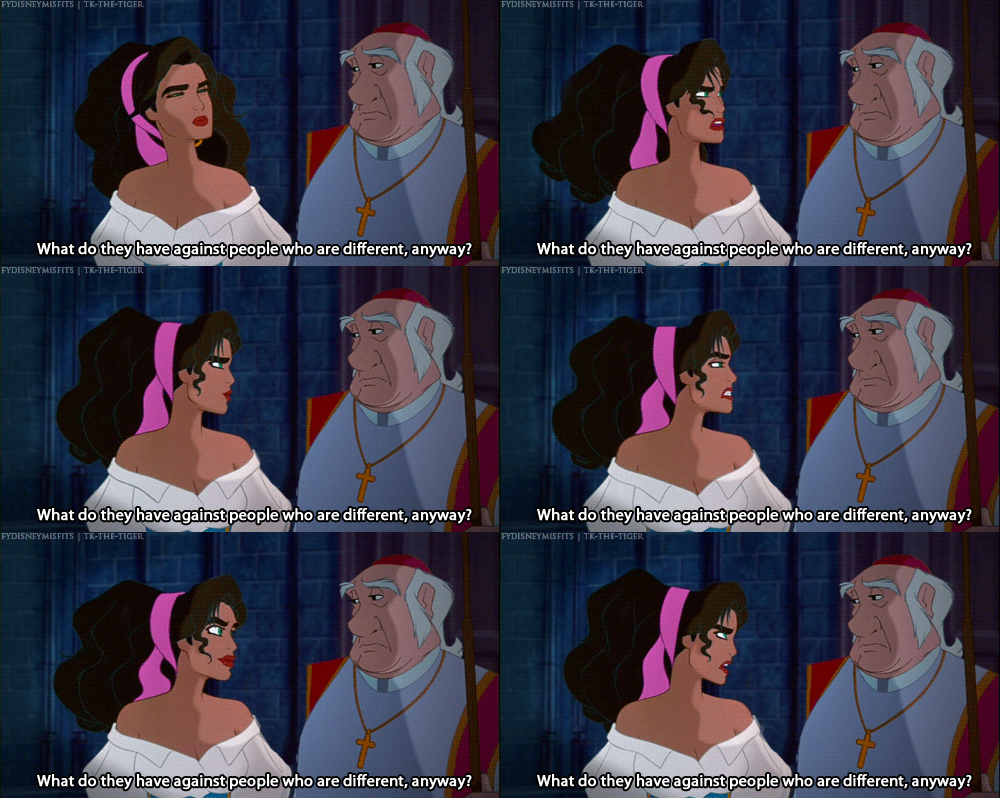
    Perhaps we should all endeavor to be like Disney protagonists once again. We should endeavor to see the inside of people different from us, to encourage the good, to subvert the system for love.
    This is what Disney taught me, and what I still faithfully cling to. This is the way of Jesus, who dined with tax collectors and prostitutes.
    This might be idealistic, but it is good.

    "God help the outcasts
    Hungry from birth.
    Show them the mercy
    They don't find on earth...
 
    God help the outcasts
    We look to You still.
    God help the outcasts,
    Or nobody will...

    God help the outcasts,
    Poor and down trod.
    I thought we all were
    Children of God."
    -Esmeralda, The Hunchback of Notre Dame

Love,
Kelley

Thursday, June 11, 2015

People Aren't Numbers: A Plea to Christianity Today

    Two days ago, leading Christian magazine Christianity Today published this article affirming their belief in one-man-one-woman marriage.
     Now, I truly believe that we must listen and learn from each other with humility and love. But I fear Mark Galli's article only serves to alienate - because despite his declared intention "treat with charity and respect those with whom we disagree," his article does nothing of the sort. Sweet words do not necessarily mean one is being respectful or charitable.
      First, despite the title, Galli cites no stats to back up his "2 Billion Christians" argument. This begs the question as to whether this estimate actually exists, or whether, once more, people's lives have been reduced to clickbait.
    Continuing with the title and lack of statistics, I really wonder how Galli intended the "Breaking News" part of the title as anything other than mockery. Again, that is neither respect nor charity. 
    Second, as I've argued before, we humans know so little about the universe and each other, that, when someone queer says "this is how I am, and God does not condemn me," perhaps it is best - the nonjudgmental, non-pharasaical way, in fact - to trust them, and let God handle the rest. To say that you know someone better than themselves is alienating, un-empathetic, and arrogant.
    Moreover, Galli claims that we who argue for LGBTQ+ inclusion are caving into culture. In this, he dismisses the work of Matthew Vines, my friend Derek, and any of the numerous scholarly Biblical interpretations that dispute Galli's opinion. 
    And, speaking of ostracism, Galli dismisses the suffering of the entire LGBTQ+ community in his implication that culture makes it easy to be queer. For many queer folk, coming out may cause ridicule, beatings, the rejection of friends and families. Coming out as LGBTQ+ poses a lot of risks, and facing those risks for the sake of justice and truth is hardly "caving into culture."
    As a Christian, I'd also like to point out that it's not caving into culture when the culture you grew up in is non-affirming (Rachel Held Evans once wrote an article articulating this in greater detail, but I can't find the link). Personally, as a straight ciswoman who could have easily blended in with non-affirming people, I spoke up because I felt I could not remain silent while any human suffered. I spoke up in spite of my culture, not because of it. 
    But Galli's dismissal doesn't stop there, and reveals something fundamentally broken in his argument. Galli claims "The church has been and remains overwhelming united," a statement that dismisses the opposing viewpoint as nearly nonexistent, mere noise created by American culture. Such a claim implies that because the opposing viewpoint has the smaller number, because these people are the minority, their voices are ultimately insignificant. The statistic that 48% of LGBTQ+ Americans are actually Christian doesn't matter. Only the majority, the privileged, the powerful, matter. 
     What Galli misses is that ignoring the small numbers only works for mathematical estimates, not for real people. Jesus, the Jesus Galli and Christianity Today and I myself claim to serve, stuck up for the marginalized. He treated every person like they mattered. 
    Ignoring the small but growing number of LGBTQ+ and affirming Christians contributes to the ostracism of this precious community. Respect and charity this is not, despite Galli's intentions. I have no doubt that he intended his article to be exactly as he claimed.
    Yet the problem is that when we aren't willing to hope the best in each other, we aren't loving each other as Jesus did. 
    The problem is that when we focus on the majority, we affirm that power, not the hurting minority, is what actually mattes. We dehumanize the minority in favor of a numbers game. 
    That's hardly respect and charity, and I hope Galli and all the non-affirming staff of Christianity Today learns this ASAP. Because this is real life, and all life matters.
      
Love,
Kelley


Monday, March 23, 2015

When Did Rules Become Tourniquets?

    I forget where I first heard this, but it bears repeating:
    I can guarantee you that there is not one person who doesn't know that you, evangelical Christian, don't support gay marriage.
    I'd also add to that. I can guarantee you, evangelical, that there is not one person who isn't aware how grossed out you are by sex not within your normal vanilla stereotype.
    I can guarantee you that there is not. one. divorcee unaware that God hates divorce.
    I know there is not one woman whose goal in life was to have an abortion.
 
    But I can also guarantee you that there's one thing most of the people you're preaching your truth at don't know.
    I can guarantee you it's their first question, too.
    Can I be loved?
    Can God love me? Can Christians? Can anyone?
 
    Yet in Christian subculture, our first instinct seems to be REMIND THEM OF THE RULEZ.
    DON'T YOU KNOW WHAT GOD SAYS. I'M BEING LOVING BY TELLING THEM ABOUT THE SINZ.
     To which I'd like to ask: if you're being so loving, then why do they keep asking this question? Why do your transgender teenagers kill themselves? Why do your women stay with men who beat the shit out of them? Why do your unmarried girls feel like the only way to avoid public humiliation is to have an abortion?
    I'm not an expert, but I don't think the problem is that we're not being loud enough in our "secularized" culture. The problem isn't "them" or their "sin natures," because for heaven's sake, they're asking if you love them. That's a good question - it's not a bad thing to want love and to want to be whole. In fact, isn't that what so many of you Christians sell Christianity as - a path to wholeness and heaven?
    The problem is, we're doing something very wrong.
 
    When did rules become our tourniquets? When did we start assuming we need to list out the rules before compassion and love? I mean, how many stories are there about the power of rules to save life?
    Now replace "rule" with love, and there's probably too many to list. Harry Potter and fairy tales like Snow White or Cinderella are obvious answers, but really Crime and Punishment, The Master and Margarita, Les Miserables, and more meet this criteria.
    Yet we keep acting like "taking a stand" for the rules is love. And it's not. It never has been, and it never will be.

    Love is patient. Love doesn't comment on advice columns warning you that your divorce is the fault of your own selfishness.
    Love is kind. Full stop.
    Love does not envy. It doesn't scheme to put more Republicans in power so you can keep the political control you like.
    Love does not boast about how keeping your 'virginity' will give you the happy marriage you deserve.
    Love is not arrogant or rude. Love doesn't claim that you're better than your sincere-hearted friend because you differ on your understanding of abusive power structures.
    Love does not seek its own. Love cares about the people on the margins. Love does not seek conservative approval by refusing to sell cake to a couple whose marriage you disagree with.
    Love is not provoked into a Twitter fight that ends (or begins) with labeling someone a heretic.
    Love does not rejoice in iniquity - I knew they were sexist/racist/homophobic because of one ignorant comment! I'm so glad I can call them out on this in front of all my followers! - but rejoices in truth.
    Love bears all things - and I think our divorces, questions, doubts, abortions, gender transitions and coming outs fall under "all." So, sorry, but refusing to sell cake to a gay couple is not love. Kicking out your queer and/or pregnant child is not love.
    Love hopes all things - for you to find happiness again, that there is a heaven and a good God and someday everyone will be reconciled to Him.
    Love believes all things - like when you say being  LGBTQQIAP wasn't a decision, I might just trust you on that since I am not you. Like when you say you're a feminist and a pro-life complementarian, I might just trust that you have genuine reasoning behind it, even if we disagree.
    Love never fails.
    Love runs besides you or lets you go when you need it and waits with open arms. Love prays and holds you and dances with you and sings over you.
    Love loves you.


Love,
Kelley

Saturday, December 13, 2014

I Am the Destructivist

    Hey y'all, hey. I only lost part of my soul to finals, meaning I'm able to write again. So let's start with something fun - like The Face of Evil.
    The Face of Evil? How is that fun?
    It's fun when evil is a cat, that's how.
 
    Given my position as a perpetually insane organic chemistry grad student, if you remember last August I got my little Sushi a brother: Myshkin.
    Secret Identity # 1: The Destructivist.
RAWR!
    Whether it's climbing the wall, swinging from the curtains, ruining each and every decoration I've put out, burrowing under the covers to attack my feet at 3 am, or eating my homework three times, Myshkin loves destruction. In fact, you might say he is in love with destruction. 

    Secret Identity # 2: The Face of Evil.
    Evil has never looked this cute. When I first met him, he was a tiny four month old huddled in a corner of a cage in a rescue home. Shy and sweet. 
    A timid personality, I was told.
    "Purrfect!" said I, naive and innocent.
    Inwardly, I'm sure that's when he started smirking.
    He hasn't stopped since.
"I may be little but Imma clog up your sink, Mommy."
    Secret Identity # 3: Ultron.
    
    I've never seen a cat scream for food louder than this kitten. Every morning when my alarm goes off, he squeals with delight - and pounces on my chest.
    (He's a good masseuse).
     We then proceed to cuddle until he decides to run into the kitchen, and then and only then may I feed the hungry barbarian.
     As he yowls and Sushi jumps up and down, as I scoop kibbles into their bowls, I tease him that he's a classic villain.
     With furs.
What flavor is this, debit or credit? Nomnom.
     But all in all, he's a sweet, attention-craving love. And life would be super boring without him.
I love my brofur, Sushi.

    There are...no strings...on him...

Love,
Kelley

Monday, November 10, 2014

I'm Backkkkk...And So Is My Unwelcome Fiend

    I really didn't mean to pull a vanishing act. My muse just...died.
    Along with my feelings, it seems.
    Because my depression decided midterm season was a fan-tast-ic time to return.
    And I was like: no. Depression can't come back. I'm on medication and I have friends and cats. Please. I'm just a bit down because my grandma is sick and my synthesis exam was the intellectual equivalent of a crucio curse.
    Never ming the familiar dull ache, the lack of interest in pretty much everything slowly spreading throughout my life. Never mind that day-after-day I felt the urge to scream and cry while sitting in my physical organic chemistry class (which I really like, for the record). Never mind the restlessness, the need to flee and find magic far away because there's no more life around or in me.
    Never mind the lie that this blog is crap and I'm going to lose all my friends by blogging terribly.

    Maybe I need to see a counselor again, but it's normal to feel stressed because look at all that's going on. I'm not depressed. I can't be. I'm supposed to wean off these antidepressants soon. I've been doing so well.
    I'm not suicidal this time, not even close, so I'm fine. 
    And yet...I'm not fine. I just want to cry. I'm scared and abnormally tired and sleep just sprays weird dreams across my weary mind. (Not that I altogether mind the dreams, since they're great fodder for stories, but more rest would be welcome).

    Still, I don't want to return to a counselor. Not because it's not helpful - it is. Not because I'm scared of them agreeing that my depression is back. Looking back, I've probably had depressive episodes since I was thirteen.
    I don't want to return because what if the counselor says I'm not depressed? What if she says I'm just a selfish, self-deluded narcissist who blames everything on her mental health because I like excuses and want to feel special?
    Ouch, that hurt to write. I guess my fear, after all this time, remains that I'm a horrible person.

    I guess I could deal with having depression, even though depression is hardly okay. I just want myself, me, to be okay. To be lovable and a good person.
    I just want to feel worthy of love. Maybe that's weak or silly or whiny, but love must be paramountly important, right? Look around us - we all need love. I really believe that.
    So I guess maybe that's why the phrase "God is love" sucks me in.
    I guess that's why I just want to hug all my friends, online and in person, and hope they know I love them, too - I love them fiercely even through the numbness.
    (Actually, I'd be down to hug nearly everyone who ever existed. If that makes me crazy, so be it).

    In working through this not-so-sane post, I see it's a good thing I made that weekly therapist appointment again. And that I found this picture:
LOOK AT THE JOY ON ITS FACE. LOOK AT THE FRIENDSHIP. LOOK AT THE CATS. 

    So, yup. That's what's been going on with me. What's been going on with you? How can I pray for you or listen to you? <3

Love,
Kelley

Thursday, October 23, 2014

Abandoning Answerianity


    Am I allowed to ask?
    Am I allowed to say it is ridiculous to bar a gay person from committing to the one they love, just because of a few controversial verses?
    Am I allowed to ask why some people insist that Jesus had to die for our atonement in some sort of child-sacrifice, when that's a very recent opinion?
    Am I allowed to say I think mainstream Calvinism, and definitely genocide, is cruel and wrong?
    Am I allowed to say I love liturgy, I really like Catholic Mass, and I believe evolution is the most realistic origin for life?
    Am I allowed to say I only want God if He is good, and if He is not good, I'd rather be in hell?
    Am I allowed to ask if God exists?
    Now for the age-old question: am I allowed to do this and still be a Christian?

    If you answered "no" to any of these questions, if my questioning is "proof" of me sliding away from faith, then...okay. This post isn't my defense of my orthodoxy or lack thereof.

    But if you're angered by my opinions and you want to know more, then please listen.
    Please, church, please listen. I am begging you.
    Can you hear our tears? Our howls of despair?
    It's the despair of a generation of evangelicals who were told Christianity is so, so much more than loving God and our neighbors.
    We were told Christianity was a culture war, to never listen to our hearts, to keep those legs shut before you ruin yourself. We were told Christianity was the Right means to heaven and the Last Days were upon us and the Earth was damned, so we might as well let it go.
    And when we started searching, we didn't find x amount of questions. We found questions that led to more questions that led to more and more (in math: not Q * x, but Q^x).

    Look at the condemnation heaped upon Gungor for questioning evolution. Look at the smug claims of "heresy" toward Rachel Held Evans for using feminine pronouns for Our God and for questioning if God really wanted Abraham to kill his child. And, of course, all those claims are done in online blog responses that leave me wondering how much you actually care about the person versus asserting how awesomely orthodox you are.
    Look at ten thousand faces abandoned by those who needed to prove their disagreement on LGBTQ issues once more, as if most people don't know how most of the church feels about them.
    Then look at those running out of church.
    If you don't see a correlation, you are very, very wrong, my friend.
    Brothers and sisters, do you know, every time you condemn them in the name of upholding what your think is true, you condemn us, too? We've gone through science classes and seen and loved people so, so different from ourselves. We cannot fit into your bubble without amputating our heads and hearts and we'll die if we do.
    You don't have to agree. I respect your differing options, and you're not evil or antiChrist or stupid for thinking differently.
    But your condemnation, your rush to prove a point over a person, your caution that we're asking the wrong questions just because they involve messy human bodies and/or weird emotions - nothing disgusts me more.
    Hey, we're a generation who's pretty screwed-up in a lot of ways, but for the most part we want justice. We want our neighbors to be loved as ourselves. And we constantly see the church denying that justice far too often.
"I'm locking you out, hooman. Hahahaha." - church and cats.
    I don't think my questions and doubts make me a heretic. I want orthodoxy. I want every. word. in. this. creed.
    I want the messy beauty of a God and Man in One, of three Godheads in One, of dying and love and resurrection and forgiveness and life everlasting.
    I'm willing to be wrong on many things. Correct me if you want. If I am heretical, feel free to email me or something. I'm willing to listen.
    Can you please do the same?
    Because every day, I'm still searching for Jesus. For the most part, I am finding Him present in Christianity, not black-and-white Answerianity.
    Only God alone is good, so only God alone is right.
 
Love,
Kelley

 

Wednesday, October 15, 2014

The Monster in the Mirror? It Isn't You

    Every morning, I shuffle to the kitchen to feed the ever-exuberant kittens. Then I shuffle to the bathroom, where I dress and clean my face and brush my hair, where I decorate my sleep-filled eyes with makeup. Where I stare at my dim reflection in the mirror.
    Every morning, before breakfast, I also twist open a white-capped, translucent orange bottle and take out a green and blue pill.
    And every morning, I swallow it with water and a twinge of thanks.

    I need us to know, I need us to understand: there is no shame in being sick.
    There is no shame in crying curled up in a corner, in clawing at despair - and sometimes, yes, ourselves.
    There is no shame in losing yourself to the black depression, in collapsing under the loneliness, in trampling yourself with anxiety, in burning yourself down with mania. In losing another battle against the addictions that provide a fleeting reprieve. Whether you swallow down the panic attack or are ravaged full-force, there is no shame.
    There is no shame.

    It is okay to be sick.
    It is not okay that we're sick, oh no. We don't deserve the torment in our mind and whatever - genetics, trauma, sensitivity - triggered it. But we are not wrong for being sick.

    Maybe there's a part of you, and me, that hates ourselves.
    When I was younger I heard preachers say we can't truly hate ourselves. There was always a small part of me that scoffed at them.
    Because somewhere deep inside, I did hate myself. I knew I deserved the bad things, the pain and anguish and tears and shame.
    I. Hated. Myself.
    And in that grotesque, insidious piece I knew I could never be loved because I wasn't strong and I wasn't brave and I wasn't...I wasn't what I was supposed to be.
    It never stopped screaming, You are not loved!

   There was a part of me, you see, so sick and black I couldn't clean it out. Devotion to prayer and Bible studies, grades, and even inviting God Himself inside me, didn't clean it out. Hatred and denial, desperation and rage didn't bleed it out.
    So I took the blue and green pills, unsure if I was condemning myself deeper, unsure if I was just plain damned. Blue, the color of tears, met green, the color of life. My favorite colors, on a simple aromatic compound that would somehow regulate the chemicals in my brain.
 
   It's a fierce fiend, that demon. But the cleansing only started when I talked about it - in therapy, with friends who (surprisingly) did love me, on this blog.
   The shame fades and fades, because the more you open up and the more people and God come in. And the more we open, the more we are changed.
   It doesn't leave easily - it's still there. Oh yes. I got a B on a homework assignment recently, and oh, how the shame washed over me again (that's why I'm writing that here, I suppose). But it is fading in the light of grace, of God and of people.

   But first, I need you to know, I need you to understand: we are all loved, and more than that, we are all wanted.
   You're not the monster in the mirror.


Tuesday, October 14, 2014

God Our Author: Annihilation vs. Creation

    As a writer, I get crazy excited about God the Creator.
    I mean, just think, He invented color. And quantum mechanics and atoms and organic chemistry and space-time.
    And people, all of us unique.
    And cats and cats and cats (I had to mention them in here somewhere).
Aren't you glad I spared you the actual Nyan Cat song?
    In Him, a God somehow three in one, a paradox of possibilities, lives redemption and resurrection and hope and love and stories. He so deeply loves His creations He became one of us.
    This seems like a God who is supposed to be good.*
    Which is why I'm always puzzled by annihilation theory - that those who don't know God simply cease to exist when they die.
    Look, I get the appeal: no eternal torture!
    But there's no peace for the annihilated, either. There's nothing. They. Are. Not.
    Annihilation is the opposite of creation. Annihilation (like eternal hell) says redemption can never be found for someone, that someone is hopeless. But unlike hell, annihilation also seems to say that God's image doesn't matter anymore. I'm not a theologian, but it seems like God's image must separate from a person, somehow, for them to be extinguished.
     I don't know whether that means God's image in people gets destroyed or taken back, but I find that quite disturbing.

    Now, I love crafting my own stories. I love developing characters, getting to know them, sometimes imagining what would happen if they appeared in my life.
    And sure, there are some stories I have decided to scrap or adapt, some characters I've merged into one or deleted from a story. But rarely, if ever, do I cut out a character without using at least a part of them in another character. It's like I can't forsake them. And I can never forget them - not even Lemon-Lime, the yellow and green cat from the first story I wrote in first grade (she had a scary encounter with a shark and ever since her narrow escape, all cats have feared water, if you must know - and yes, I did name her after my favorite sherbets).
This poor cat may want people in hell after this, however. 
    If I, a mere mortal and a sinner saved by grace, cannot forsake my characters, how can God utterly erase those He has created?

    Maybe there's an explanation outside of this world, since that's where God is.

    But wouldn't He have to stop loving the annihilated? Wouldn't love have to stop, because the person no longer is? Because, in annihilation (and ECT), love can no longer "hope all things."
    The idea of a perfect love like God's ceasing is, again, quite disturbing.

    I know there's plenty of compelling evidence for annihilation in the Bible. There's plenty of evidence for ECT, too, and even Christian universalism. So if people want to believe that, I'm not one to judge.
    But - but - can we stop pretending it's more merciful?
    Because it involves a person extinguished. That's really disturbing. To me, it's more disturbing than eternal hell.
    I know, I'm getting emotional here. So...if I've overlooked or misinterpreted something, do let me know.
    What are your thoughts? If you believe in annihilation, what have you found compelling about it? How do you reconcile annihilation and the Imago Dei?

Love,
Kelley

* Problem of Evil to be incorporated into third post.

Sunday, October 12, 2014

I'd Risk A Thousand Shelobs For You

    Do you know, I'd cross the expanse of space-time to get you back?
    Do you know, when I say hello and you look everywhere but my face, I'd risk a thousand Shelobs to have you smile at me?
    Do you know I'm sorry I kept thinking I'd have time to talk on the phone to you, but it was always, always later? I'm so, so sorry.
    I'm so sorry.
    I'd sacrifice my own mental health if I could feel your tender arms around me, knowing who I am.
    I'd go through a hundred Odysseys, descend through a million circles of hell, to find your memory and relieve your suffering.

    I'm still praying for you. You've got me praying regularly again, of course you have.
    I know you always prayed for me, and honestly, I wonder if your prayers are the reason I survived this far.

    You seemed to recognize me for a little while, twenty minutes or so. You told me the story of when you were little and a hurricane blew your roof off.
    You grew up so different from me, an extroverted model, the second-youngest of seven siblings who married a wonderful Italian-American while she was still a teenager. I remember you telling me about your adventures with your sassy sister Phyllis, about your boyfriends and your ice cream job.
    I remember how you got your license even though you didn't need it, how you went to college when you were older,  how you worked until 82 because you liked it.
    When I was little I wanted to write a novel based on you. Sometimes I still entertain the idea.
 
    Do you know your house was my safe place when I was little? How I looked forward to our visits like vacation? The rhythmic rush of cars down the main street, Papa chasing us twins as the Big Bad Wolf, drinking "fizzy water" at your minibar and playing in the triangle-shaped tub, they were such soothing treats to my little soul.
    Your generosity, in true Italian family style, is still what I think of whenever I'm serving pasta or ice cream.
    It's only a slight exaggeration to say your fudge changed my life. And the bacon - my word, I got sick on too much bacon at your house once!

    And do you know your orange tabby, Terry, was the one who triggered my love for cats?

    I love you. I miss you.
    Mimi, I hope I'll see you again soon, in the hospital or (I hope) back home. And I hope this time you'll see me, too. There is so much love, you know, our days can never be enough, but I guess that's how love is.
    I guess you already knew that, though.

Love,
Kelley

Wednesday, October 8, 2014

God Our Author: When Love Tortures?

 
Random: I still love this movie.
    The idea of hell never used to bother me. Like any good Christian child, I knew it was a necessary evil, something Jesus spoke about more often than heaven.
    Then I went to college. And met more and more people who didn't believe in God, or Jesus.
    My heart and my head and my stomach pounded, twisted, vomited, at the thought of them in hell.
    I would go to hell in place of them, were it possible. Perhaps that meant I didn't have a proper view of the glory of God, but I couldn't let my loved ones suffer for eternity (a theory called Eternal Conscious Torment).
     If they were in hell because, for whatever reason - be it suffering, confusion, unanswered prayer, lack of belief - they didn't follow Jesus, there was no heaven. Not for me. Either God would have to brainwash me to forget them, or His glory would simply outshine everything else.
    But forgetting someone you love? Ceasing to love them?
    I felt even queasier.
    They were people, created by God. In that sense, can not loving people can be a way of loving God? How could ceasing to love them be moral?
    My morality is depraved and confused.
    Now, I don't deny that this is true. My thoughts towards, say, ISIS at the moment involve quite a bit of F-bombs and murder (sorry).
    But how is torturing people alive (be it through actual fire or the lack of His presence) for a few years, for a vapor, of evil, justice?
    My morality is intact enough to know that it's wrong for me to, say, kidnap a terrorist and torture them for the rest of their life. So how is it good for God to do that for eternity?
    I don't grasp the evil of sin.
    Since I still mock and hate and gossip and lust like many people, yeah, clearly I don't.
    But I know, good heavens, God has to be just, because justice is good and God is good.
    So is hell justice for a crime I can't even see?
    I'm not convinced. Because what if justice is mercy, and mercy, justice? What if they are, pardon the cliche, two sides to the same coin? (For instance, for a murderer, maybe punishment in prison is a mercy because they now face the reality, at least physically, that what they did was wrong).
    So is hell a mercy?
    I don't know. I don't think so, honestly. Prison is really not the same as eternal torture.
    Now I fully realize we're all trapped in this world and, yes, it's true that we don't grasp the depravity of our sin. But because of this, we also don't grasp how good God is.
    I'm unconvinced that I can be more merciful than God. I don't deny that I'm a worse sinner than I know, but I'm not sure my conscience is wrong for being too sensitive, too good.
    Because I'm not sure God can ever be too good. It truly bothers me that the same people arguing for our inability to discern how evil is really good for God, are often the same people arguing that our consciences prove His existence. I know their argument is that only a semblance of conscience remains, but ... it doesn't sit well with me.
    The Bible says God is Our Author.
    As a writer, I love my characters after a fashion. I delight in them, the good and the bad. My heart sometimes aches when they make wrong decisions and do terrible deeds. My ire awakes, and by the end of the story, at the very least some sense of hope must remain.
    I cannot imagine creating a character, even a deplorable one, and writing about their eternal torture forever and ever. I even have sympathy for the villains I'm writing about now - so many factors, good and bad, have influenced their decisions.
     What kind of sadist would I have to be to write about a bad person for a chapter, say I love them, and then revoke my love (because Love Does Not Torture) and describe their hideous, beyond repugnant agony for the remainder of the book? (With an epilogue saying "the anguish will never end. Glory be!").
    Hey, it might sell nowadays, who knows. But that's kinda sick.
    God isn't sick.
    And so this is why I am very, very uncomfortable with "Eternal Conscious Torment" theory.
    Do you believe in hell, and if so, why? What are your thoughts, questions, sentiments?
 
    Eternity is kinda a topic I like looking into, even though it's impossible to know. But I do think it can have a negative or positive effect on human relationships, so I will talking about it on this blog for the next few entries.
    As for annihilationism and Christian universalism, stay tuned for Part 2 and Part 3 of us exploring eternity from the perspective of God being Our Author (but, spoiler alert: don't hold out hope for a conclusion).

Love,
Kelley


Thursday, October 2, 2014

Killing My Church Darling

    Within the the never-ending advice to writers, one common phrase is "kill your darlings."  
    That beautiful passage you've written?? That scene you love, love, love so much, even though it doesn't quite fit into the direction your story is taking?
    Kill it. Edit it out. (I have personally spent many an agonizing day on editing issues).
    And man, is it painful. Because, like, my story won't be the same without that golden metaphor right there...AND I LIKE IT THERE!!!

    Now, there's probably many real-life analogies we could make here. One particularly relevant one for me of late has, for better or worse, been church.
    Church had been my darling for a long while. My attendance proof that I was The Good Christian Making Effort to Keep Up With God. Oh heck no, I wasn't walking away from God. Not me.
    Then, last winter, when I started climbing back up after months of severe depression, I realized I was just plain sick of church.
    Not of God or people (okay, not most people), but I was sick of doing What I Was Supposed To Do. I was sick of following a formula that, for me, led to more anxiety and frustration than anything else.
     Simultaneously, I began reexamining my beliefs in general, a reexamination catalyzed by the advice I'd often received: "spending more time with God" would cure cure my depression. Because I now knew this wasn't necessarily true, I began wondering what else might not be true.
    And as welcoming, as nonjudgemental, as lovely as my church in Boston was, I became very angry at Christian Culture in general. I was furious that mentally ill Christians are largely considered "lesser" for their struggles. I was furious at the way many denominations reflect our culture's oppression of women, dressed up in hollow words like "God's design." I was furious at the way many Christians thought abandoning a child would convict gay couples of their sin.
    I'm still furious, to be honest.
    So I killed my darling. Meaning I cut out church out of my life for nearly a full semester. Silently I fretted that I'd slipped away from God and was sliding down a path of eternal damnation, but those Sundays at home certainly left me in a less anxious go-go-go state of mind.
    Then I went to the Mideast and saw people who acted out the part of church for me. I finally felt what my pastor had been saying for years: church wasn't a building or an event, but people. I was safe, happy, loved, and free, free, free, with these people. We could question and doubt and cry and laugh and embrace and be embraced and all that truly mattered was Jesus loves us all. Not to say there wasn't conflict and everything was perfect, but we were a community.
    So when I moved to Cambridge this fall, I was like, sure I'll try church again.

    And then I realized just how many churches there are in Cambridge.
    Shoot.
    Thus far I've visited a modern evangelical church, a Southern Baptist church, a Catholic Mass, and an Orthodox Liturgy. And, yeah, I had some fears about all these services, along with some admitted prejudices against Southern Baptists. But instead of having my fears met, I found lovely communities where people were friendly, welcoming, and not judgmental.
    There were no assumptions that I was a heathen who needed to be interrogated on Gospel 101. Only kindness. Love, maybe I would call it.
    "What's your name?" asked countless of the people at the Baptist church.
    "You're so colorful," said the Catholic priest by way of greeting, which made me grin (I wear bright colors because they make me happy).
    "You can't do anything wrong here," assured the Orthodox Father with a gentle smile.
    And then I realized "I like all these churches now-what-do-I-do," and "Oh yeah, I wanted to try the Episcopal church and that other Baptist church and the Lutheran church too. And the UCC" - now that I finally realized they're not universalist.
    And that's how my anxiety started settling back in.
    So: I decided this semester will be dedicated, on Sundays, to visiting churches of all different traditions. So far God's shown up in the music of the evangelical church, in the people of the Baptist and Orthodox church, in the hymns of the Catholic church. Maybe next time He'll show up with a talking cat, who knows.

    I don't know exactly what I'm looking for in a church. Someplace where questions are encouraged and people love God and me.
    It'd be kinda nice if God would drop a sign and say "Here is Where You Should Attend Church Kelley," but I doubt He will (feel free to surprise me, Jesus).
   Until then, I guess I'll have to content myself with waiting and searching. Nice life lessons, I suppose.
    In retrospect, killing my darling wasn't so bad after all.

Love,
Kelley

Tuesday, September 16, 2014

The Bible Can't Save Us

    The Bible cannot save me.
    The Bible can't save anyone.
    Certainly the Bible is profitable for doctrine once understood in its context. But the Bible cannot save us.
    The Bible did not redeem me. The Bible is not the Word in the Beginning.
    The Bible cannot love me, or you, or anyone.
    The Bible cannot whisper the voice of God. Certainly God can whisper through the Bible, but the Bible is an object. A holy, inspired collection of stories, both poetic and narrative, yes, but it's still an object.
    The Bible is not God. We were created by a Trinity, not a Quarterinity (which isn't even a word, but you get the point).
    And so, the Bible cannot save us.
***
    I've been wanting to pen this post for a while, but I hesitated because people will judge me I know I'm a bad Christian could anyone relate?
    But a few days ago a lovely post went up at Sheloves Magazine from a writer named Heather, explaining that she stopped reading the Bible because reading it shredded her heart every time.
    Which is basically my story, too. Tears pricked my eyes when I read Heather's words because I thought that, just maybe, I felt God whisper to me through a blog post.
***
    I've written a bit before about my struggles with scrupulosity.
    So when I hear the typical evangelical encouragement to memorize Scripture, I cringe, because they don't know how much I've done that. How much I chanted verse and prayers in my head whenever I faced temptation, repeating them until I got them worded exactly right. Exactly.
    When I hear a well-meaning pastor's encouragement to get up early each morning and read the Bible, I feel cold. Because they don't know about the times I spent an hour meticulously reading every. word. of a chapter, making sure I knew every freaking definition, making sure I gleaned meaning from even the most tedious verses (hence why I hated Ezekiel: and he took his rod and measured, and the temple was this many cubits by this many cubits...).
    These compulsions were so ingrained in me that, even when I ignored God in all other aspects of life in high school, I continued my chants and prayers.
    And naturally, when I finally decided I wanted God again, I started reading the Bible with renew purpose.
    Every. Day. Making sure I underlined and reread anything I wasn't getting meaning from. I took special care on the days before college exams, so God would bless me on the test and not punish me for putting biology/chemistry first.
    I was scared, I think. I wanted to Do The Right Thing, and the Right Thing was a formula that fit everyone.
Geez this image triggers anxiety.
    But formulas and feelings only take you so far. When the stress and anxiety began piling on junior year of college, and when the depression collapsed senior year, my Bible reading collapsed into a formula devoid of meaning.
    I kept reading, determined to affirm I was still following a God I doubted and couldn't hear from, so people couldn't accuse me of being depressed because I'd fallen away from God (for those who don't speak Christianese, "falling away" describes the unintentional process of prioritizing the secular over God until we no longer care about Him).
    Heck, even when I started recovery and my church attendance plummeted whilst I began re-examining every belief, I still read daily. No longer a chapter, however. I just read a story of Jesus' ministry.
    I was disappointed that nothing changed. I was still doing it because I had to. Bible devotionals incited rage or gave me panic attacks.
    When I returned from the Mideast, I have to admit, my daily Bible readings went the way of the dodo bird.
    Strangely, not reading my Bible every day, I felt closer to God.
***
    I want to love the Bible.
    I don't think I do.
    I love what the Bible reveals - a God who loves us, who told us to love Him and others as the greatest commandment. A God who came to earth to live among us, a God who would rather die Himself than kill us. A God who defeated death, a God who promises that life ought not be how it is, who promises that He is alive and restoration will occur.
    But I'm horrendously confused by the Old Testament stories of God-approved genocide, and I'm ripped apart inside when I read of a lake of fire. I'm repulsed by the use of Bible verse to bash the victimized while we conveniently ignore Matthew 7:1.
    I know there are books dealing with these messes. Peter Enns just released a book on it. Maybe I'll do some reading and come away with a different perspective, ready to read the Bible again.
   ***
    Heather said she just wasn't ready to read the Bible yet. I guess you could say that's where I am, too.
    It'd be nice to wake up each morning and treasure the Bible. But I'm not there yet, and I'm not sure when or if I will be.
    I guess it's good then, that the Bible doesn't save us; God does.

Love,
Kelley

Wednesday, September 3, 2014

Stories That Changed My Life

    Okay, I'm a ravenous fiction addict, so... because I'm short on time and long on problem sets and procrastination, here's a list of ten books whose stories have continued to haunt/inspire me long after I finished reading them. Basically, they're novels that have changed my life. 


1. Crime and Punishment
    You don't want to know what I would do for half the writing mastery Fyodor Dostoevsky possessed. Seriously, who else can weave the story of an axe murderer's existential crisis under the guidance of a saintly prostitute, and keep it terribly beautiful? If you're filled with hatred of humanity, this story will both affirm your rage while stirring your hope in redemption.

    Quote: “Taking a new step, uttering a new word, is what people fear most.” 


2. Anna Karenina


    Russian Literature is where it's at, my friends. Ahem. Anyhow, Tolstoy himself esteemed Anna Karenina above War and Peace (which you should also read). The magnificent characters come across so intricately human you feel you could meet Anna or Lenin if you walked out your door. No human emotion and thought was too silly, wicked, idealistic, or noble for Tolstoy to record, and so I couldn't help but identify with all of his characters, noble or base. Plus, there's a portion of the story Tolstoy writes from a dog's the point of view, so all animal enthusiasts will have one more reason to love Anna Karenina.

    Quote: “All the girls in the world were divided into two classes: one class included all the girls in the world except her, and they had all the usual human feelings and were very ordinary girls; while the other class - herself alone - had no weaknesses and was superior to all humanity.” 


3. Les Miserables
    What draws me to mercy? What draws me to showing compassion? Victor Hugo's iconic image of the Bishop of Digne freeing the thief Jean Valjean and giving him his most valuable items. The Gospel of Jesus is acted out through the Bishop, and his impact on Valjean's life is inspiring beyond words.
    Quote: "Before him he saw two roads, both equally straight; but he did see two; and that terrified him--he who had never in his life known anything but one straight line. And, bitter anguish, these two roads were contradictory.” 


4. Waiting for the Barbarians

   J.M. Coetzee's Nobel Prize winning novel is written in an enchantingly simple yet poetic prose. Too bad that's all that you'll find enchanting. A story set in no discernible time nor discernible location, where most characters have no names, Waiting for the Barbarians examines a man's struggle for morality as fear of the indigenous barbarians leads the Empire to dehumanize anyone who opposes them. It's graphically violent, graphically sexual, and above all graphically human. I've never had a novel make me cry and scream and cheer through my tears in one page. Read it when you need your heart broken.

    Quote: "‘Look!’ I shout. ‘We are the great miracle of creation! But from some blows this miraculous body cannot repair itself! How—!’ Words fail me.  ‘Look at these men!’ I recommence. ‘Men!’”


5. Frankenstein 
    Besides that Victor Frankenstein is a chemist (hehe), Mary Shelley's masterpiece has made me re-examine everything from my purpose in creating, my view of others, compassion and justice, to my view of God. Grim but so, so necessary - and convicting.

    Quote: "'Accursed creator! Why did you form a monster so hideous that even you turned from me in disgust? God, in pity, made man beautiful and alluring, after his own image; but my form is a filthy type of yours, more horrid even from the very resemlance. Satan had his companions, fellow-devils, to admire and encourage him; but I am solitary and abhorred.'"


6. Harry Potter 

   I didn't read J.K. Rowling's epic series until last year because the whole witchcraft thing weirded me out. Then I read a story of love and good vs. evil in a world we all want to join (you can admit it). This story is peppered with stunningly complex characters like Severus Snape and Sirius Black, whom you love despite how uncomfortable their actions make you. Plus, Hermione is one of the greatest female characters of all time. She's a genius who shows you don't have to be kickass to get stuff done (not that kickass is bad, but, well, I'm just not). It'll rekindle your belief in good again. 

    Quote: “Of course it is happening inside your head, Harry, but why on earth should that mean that it is not real?”


7. The Lord of the Rings
    As a writer of fantasy, of course I had to include Tolkien's renowned tale. Besides friendship and breathtaking world building (I am forever dissatisfied that we don't know much about Beluthiel's cats) Smeagol's fight with Gollum's very real addiction to the Ring transforms him from a pitiful character to someone most addicts can all identify with, however uncomfortable that may make us. Plus, the ending will leave you aching.

    Quote - "Not all those who wander are lost."


8. The Chronicles of Narnia

    My introduction to the wonderful world of fantasy began with C.S. Lewis's The Magician's Nephew, and I've yet to stop obsessing. Theological musings mixed with children's stories; how can it get better? And I found myself, like the many marvelous characters who undergo drastic change as the books progress, altered after reading these stories.

    Quote -  “'It is very true. But even a traitor may mend. I have known one who did.' And he looked very thoughtful.”


9. The Master and Margarita
    I've returned the list to Russian Literature, surprise. Mikhail Bulgakov's novel is bizarre and satirical, two things I don't normally enjoy. And I didn't enjoy them in The Master and Margarita, either. But I've kept coming back to this novel and all the questions it raised in the years following. I mean, when Satan's visit atheistic Russia becomes entangled with a married woman who wants to find her unjustly imprisoned lover, who happens to be writing a novel based on Jesus' crucifixion, masterful (pun intended) musings on theology, fantasy, Russian literature, and mercy are bound to occur.

    Plus there's this fantastic quote: “Follow me, reader! Who told you that there is no true, faithful, eternal love in this world! May the liar's vile tongue be cut out! Follow me, my reader, and me alone, and I will show you such a love!” 


10. A Voice in the Wind


    Francine Rivers' novel is technically classified as Christian literature, but I think that people of most religious beliefs could enjoy the story of a Jewish slave girl in Rome, who falls in love with her wildchild mistress's brother. The character development, especially in Julia Valerian, is flawless. Flawless, I tell you. I've never been so desperate over a character's choices.

    Quote: “'Can you see air you breathe? Can you see the force that moves the tides or changes the seasons or sends the birds to a winter haven?' Her eyes welled. 'Can Rome with all its knowledge be so foolish? Oh Marcus, you can't carve God in stone. You can't limit him to a temple. You can't imprison him on a mountaintop. Heaven is his throne; earth, his footstool. Everything you see is his. Empires will rise and empires will fall. Only God prevails.'" 


    Really, the list is a lot longer, but I stopped at ten. Now it is your turn, mwahaha - and you don't have to stop at ten, even! What stories have changed your life? 


Love,

Kelley

Saturday, August 23, 2014

Down with the Progressive Police.

    For all the progressive talks of "inclusivity," progressives are often as exclusive as the conservatives they like to demonize.
   
You shall not pass because I'm assuming you have bad intent. 
    I realize I'm probably going to take some heat for this. And my title is pretty combative, for which...I'm not sorry.

    I've had it with the progressive hypocrisy. I'll only apologize if I've failed to consider a perspective, so if I go wrong here, let me know how and why you're concerned.
    I'm writing this because I'm growing very troubled by the progressive policing I see happening on the blogosphere and on Twitter.

    Examples:

    You can't be a feminist if you're a man (why? Because they can't fully understand what it's like to be discriminated against? Do we really want to draw discriminatory lines like this? If they actually, truly respect a woman as fully human - none of that "equal but different roles balderdash - I want them to call themselves a feminist. The label "feminist" has been too much maligned as is).

    You can't be a feminist if you're pro-life (Because if one acknowledges a woman as fully human, they must suddenly realize that pro-choice is their only option. There's no room for growth. You believe XYZ so you must believe ABC, or you don't believe XYZ. Yeah, no).

    You can't talk about race if you're white (This one is kinda true. You don't get to say you know how it feels to be a racial minority or discriminated against. You better shut up and listen to people of color before opening your mouth. But you can humbly participate in raising the voices of those who've been oppressed by racism, which is, I suppose, technically talking about race, just in a different manner).

    It's not my job to educate you on LGBTQ/woman's/race issues (so how do others find out about this stuff, hmm?).

    Don't tell me to be nice. That's tone policing! (Ah, because kindness has nothing to do with love. Funny how those supposedly narrow conservatives advocating "love the sinner, hate the sin" use the exact same reasoning).

    Progressive Christians in particular love to talk about inclusivity. "The kingdom of God is controversial in whom it lets in" and all.

    Too bad the more progressive/post-evangelical Christians (which includes myself, I suppose) are incredibly hypocritical here.
    We love to cast down the sexists/racists/bigots. Good. Ain't no place for that in God's kingdom.
    And then we kick them when they are down. Eh, I don't think that's in God's kingdom either.
    But, for examples, see:

    1). Exultations over Mark Driscoll's demise, which, though he deserved to be reprimanded/removed for his horrific bigotry, he did not need many people who don't know him offering their opinions, judgements, and castigations. Discussing the systems that allowed his problems to continue is completely different than personal attacks and speculations.

    2). People shaming pacifist Brian Zhand's initial comments on Ferguson. Rather than expressing caution about the implications of what he said, people immediately assumed he wanted to silence the outrage and decided Twitter was the loving, Jesusy means to demonize him.

    STOP.
    I'm worried that Christians arguing for more inclusivity are, in fact, becoming as hostile as those they claimed to be different from. Except they're trading focus on personal sins like lust for fashionable, systematic sins like bigotry.
    We will be known as his disciples by our love. That's it. Love! Don't you see?
Yes, the Beatles had it right. All you need is love...
    Love involves calling out stupid shit. Love involves keeping out harmful ideas. But love doesn't involve public shaming techniques that only serve to draw more barriers to exclude more people.
    Please, for the love of God himself, see people as the very image of God around you. Please, for the love of God himself, try to assume good intent when you're inquiring about a questionable statement.
LOVELOVELOVELOVELOVE!

    I'm just as guilty of this as then next person. We all need to stop.
    I really am starting to suspect that  assuming malevolence is pure evil. Maybe I'm wrong. Maybe I was mean in this article; I don't know. I was definitely more direct and harsh than normal.
    Where do we go from here? How do we stop judging and start loving? Am I missing something here, being judgmental myself, or just plain wrong?
    Let me know.

Love,
Kelley

Thursday, August 7, 2014

Question of the Week: Demon Possession or Mental Illness?

   I'm curious about the relationship between whatever is mental and whatever is spiritual.
   It seems to me that a lot of mental processes are often attributed to the spiritual. For example, maybe I have a subconscious desire to do something. I could easily interpret that desire to be God telling me to do something, when in actuality it's just me.
   Or, I could feel angry for no reason. I could then attribute my anger to spiritual warfare, when in actuality, maybe I'm just having side effects from medication. And I guess this question troubles me because, um, attributing our mental processes to the spiritual can certainly give an easier answer than looking within ourselves.
   So: I suppose I see why it's easy for people to dismiss the mentally ill as influenced by demons. Our brains aren't really diseased, we're not really weak - it's forces we didn't create and can't contain.
   Of course, I don't believe this. My depression was caused by anxiety, which in turn was caused by untreated wounds from my past. Not demons.
    Yet in the Bible, God is said to have sent a spirit to afflict King Saul with depression.
    Moreover, the New Testament if rife with people who seem to display symptoms of epilepsy or schizophrenia, yet in the Bible they're called "demon-possessed."
    Naturally, this raises a mountain of questions that can only be answered with speculations. Ick.
    Oh, right, I love those questions.
    First and foremost, I'd love to ask: were these people actually possessed/afflicted by the spiritual realm, or was misunderstood mental illness the cause of their suffering?
    Some people stick to the demon interpretation, pointing to the fact that the "demon-possessed" people in the New Testament seemed to have knowledge of things they should not have known, such as the serving girl who knew that Paul proclaimed Jesus as God or the young man who could apparently discern those who truly believed in Jesus and those who didn't. They claim that most mentally ill today are probably suffering from a legitimate mental, and not spiritual, disorder.
     I suppose my objection to this theory is simply that, well, aside from suprerior knowledge, the descriptions seem nearly identical to mental health issues. And why would demons inhabit children, like the epileptic child?
     A second interpretation assumes that the Biblical writers simply attributed mental illness to demons because they lacked sufficient knowledge of mental processes. Jesus either just didn't bother to correct people, or, since he was in a human form himself, was limited in His knowledge (I think C.S. Lewis once said that he saw no incoherency between Jesus' deity and limits to his knowledge in human form, so please don't kill me for saying this).
    I suppose my main objection to this theory is, if Jesus knew, why didn't He say something? You know, a lot of mentally ill have been treated like crap throughout history due to misunderstandings like this (in fact, they still are). Maybe He could have helped us! And if He just didn't know, what do we make of His seemingly psychic abilities with the woman at the well?
    So: I'm in a bit of a conundrum. Problems abound with either answer, I think.
    Like I said at the beginning of this post, I don't think it's possible to find a definite answer to this question.
    I suppose the answer of Jesus to the mentally ill - love, compassion, yes I'll help you - is the real takeaway, the more pressing question from these stories, be the culprit demons or a troubled brain.

     Still, I would love, lovelovelovelovelove, to hear your perspectives on this. Pretty please?
   
Love you all,
Kelley