Showing posts with label Science. Show all posts

Sunday, June 21, 2015

Pope Francis, Climate Change, and That Evil Liberal Scientific Agenda

    I have a confession: we scientists do have an agenda.
    It's learning.
    We like making discoveries. I'm a graduate student at MIT; of course I want to synthesize a cool new catalyst. Biologists want to discover the cure to cancer. Ecologists want to figure out a way to stop climate change, and neuroscientists want to understand how our brains work. Discoveries are our agenda.
    Moreover, in our private lives, I'm sure every one of us scientists has a social and political agenda. We're human, and we feel and believe things things as much as non-scientists.
    What we don't have is an agenda that mixes our evil liberal ideology with our science.
    Really. I promise.
    Science is mostly gathering and analyzing data. When neuroscientists discovered that transwomen brains function more like ciswomen brains, and that transmen brains function more like cismen, that's called data. Data is fact. The interpretation - that transgender is a legitimate identity and that people aren't lying when they say "this is how I am" - can be debated. The similarities found between transbrains and cisbrains, however, are not up for debate.
    Likewise, when ecologists and geologists discover that the earth's climate is changing, that's data. The cause and consequences may be debated, but you do not get to deny the data.
    So we can debate Pope Francis's encyclical all we want. We can disagree with his interpretation all day long.
    What we cannot do is deny the facts- climate change is real. And yet...
    So many conservative Christians - the community I hail from - do. Because scientists transform the magic and mystery of the world into facts, many Christians assume we are attacking religion, which is fundamentally associated with invisible, supernatural mysteries.
    Except, I'm a Christian myself. 33% of us scientists do believe in a god, and another 18% in some sort of higher power. So, while scientist may be less religious than other American populations, it's hardly accurate to say that science has an anti-religious agenda. 
    Basically, science is not a crutch to be twisted at will, as I was told earlier this week. The scientific method relies on skepticism and repetition and fact. Yes, there's interpretation, but typically we go with the simplest interpretation in accordance with Occam's Razor.
    So Pope Francis is not betraying the Christian faith when he says we are facing a climate crisis. He isn't siding with a liberal, anti-thiestic agenda. Rather, he has read and interpreted a deluge of scientific data as accurate, and decided that, as "the earth has been given to us" by God, we should care for it.
    Trust in science is not a betrayal of faith. It is not a political decision, or at least, it shouldn't be. Science is merely our attempt to discern facts about the natural world.
     Yes, we scientists are flawed and we will misinterpret and make mistakes, but that's why peer review and verification exists. No, the scientific method is not the be-all, end-all of reality, but few scientists would claim it is. Yes, we can, and perhaps should, be skeptical of scientists - and religious leaders and politicians, too!
    What we cannot do is dismiss people, whoever they are, as driven by an liberal, evil, anti-thiestic agenda just because it upsets our notions of how the universe works. We cannot deny facts just because they challenge us.
    Because then we're the ones motivated by a dangerous agenda - pride and trust in our own beliefs as fact, when all data contradicts us.

Love,
Kelley

Tuesday, May 12, 2015

Regarding God, the LGBTQ+ Community, and the Universe

    Whether you're a creationist or an evolutionist or in-between, you probably recognize that we humans are an evolving species.  
    Right now we look at the Middle Ages and wonder how people thought stench caused everything from chlamydia to the Black Death. During the Renaissance, just how did the Catholic (and Protestant, for that matter) church believe that geocentrism was vital to the authority of the Bible? We look at the colonial world and wonder how people attributed authority to the whiteness of their skin (not that our current time is doing particularly well on this front, either, ahem-ahem).
    But, seriously, in a few hundred years, it's likely people will be looking back on us and our ideas and our beliefs and wonder, what were they thinking?
    Just stop for a moment and consider one of the basic teachings of quantum mechanics. Most people know visible light is part of a wave of electromagnetic radiation. But did you also know that light has mass? Light has properties of both particles and waves.
    And so do the electrons and protons and neutrons in atoms, which compose our world. You have a wavelength, albeit an extremely teeny one.
    It's hard to picture. Now go read about quantum entanglement and comfort yourself with the idea that Albert Einstein himself rejected this theory.
    I've never heard of anyone able to visualize more than three dimensions, either, although the prominent String and M theories rests on the existence of ten or even eleven dimensions - including space-time. Because, time is a dimension just like up and down, back and forth, side to side.
    Let that sink in. Try to picture it and not have your mind blown (if you can, please go into science, we need you).
    Oh, and science still hasn't solved the mystery of consciousness.
    For all our technology, we still know very little about the universe. It doesn't fit how our minds are conditioned to think.
    I mean, just watch this video of the Andromeda galaxy: just one galaxy among who knows how many. Our universe is insane.


    So let's get a little more personal. Who are we to think that we can comprehend the entire spectrum of gender identity or sexual and romantic attraction? Who are we to think we can know what someone should be like based on their genitalia?
    It makes no sense. It takes a great amount of arrogance to deny what our fellow humans tell us about their experiences, to insist that our puny boundaries work perfectly in a vast and unfathomable universe.
    But the Bible, one might say. To claim that it gives us gender and sexual boundaries isn't arrogance. 
    And I would have to disagree. Because isn't it possible, just possible, to think we've been reading the Bible wrong, just like we read it wrong on women's equality, just like we had read it wrong on geocentrism?
    (Plus, isn't it possible to assume that a community that undergoes a tremendous amount of persecution and suffering for saying that they don't conform wouldn't say it unless it was true?).
 
    My fellow Christians, why do we want a God who boxes us in?
    Didn't Jesus come and show us that, oh hey, justice and love and compassion are the way of God - not the judgmental violence we humans still utilize even now, two millennia later? In a sense, doesn't Jesus challenge us to rethink our assumptions about what our lives, our mini-universes, should be like? Maybe He would like us to do the same to the whole universe, no?
    The fullness of God is incomprehensible. How can we then use a God so high above us to box us in?
    Certainly we could portray God's command not to kill as 'boxing us in.' But is the command, especially when coupled with Jesus' claim that even to hate is to kill, so much a prohibition as it is a pointer towards the proper action that occurs when we love each other? Because loving someone doesn't involve killing them.
    In contrast, I cannot see how, if you love someone, you won't let them marry if they are not harming anyone. I can't see how loving someone means they must identify with the genitals on their body, no matter the pain. That doesn't make sense to me.
    Relatively, we know very little about the universe, much less the God who created it. Can we please stop pretending we do?
    Feel free to argue (with love) in the comments.

Love,
Kelley
 

Monday, September 29, 2014

Religion and Evolution Without Gymnastics: A Response to David P. Barash

    Keep calm, I tell myself. Keep calm.
    But illogical arguments don't sit well with me. Typically I ignore them. Okay, half the time I ignore them. And by ignore, I mean I don't rant online about them, just to my cats or my sister.
    Ahem.
    But since this latest piece deals directly with science and religion, two things I'm pretty passionate about, I'll respond. (Also my dear twin asked me for my thoughts).
    So, last night my sister forwarded me an opinion article published in The New York Times, written by a biology professor named David P. Barash. Dr. Barash presents, once again, the argument that God and science are incompatible masked as a defense of evolution.
    I've heard this a lot, and I used to believe it. Now I don't, so I'd like to respond to Dr. Barash.
    But, first of all, I'm aware that Dr. Barash is a distinctive scientist, whereas I'm, uh, just starting a PhD program. I respect him as a scientist who knows a heck of a lot more than me about science, but I don't think that means his arguments are above critique.
    Also, I'd recommend you read the article before continuing, or I might sound (more) nonsensical.

    Okay, ready? Let's go through this.

     1. I’m not a legal expert, but I would like to know if this "Talk" violates separation of church and state. If I'm wrong, do inform me. Update: see comment below. It doesn't. It helps having friends who know legal issues. :D
     But I still find it problematic that he's saying he wants his students to choose, while telling his students "they will have to undertake some challenging mental gymnastic routines.” That’s as close to saying “your belief is wrong and as a scientist you can’t believe in it” as you can get without saying it outright. And if they’re not asking him his opinion, he has no right to give this indoctrination - I mean, talk. They signed up for biology, not philosophy. Your job as a professor is to prove evolution, not the lack of logic in religion. 
     2. Granted, he says his point is that evolution is correct and we can’t twist science. Well, yes, we can’t twist facts - including evolution (yes, I agree that evolution is true). But in his essay, he focuses more on disproving God’s compatibility with evolution than ACTUALLY proving evolution, which makes me question his true motives. But, again, I don't know him personally and it's hard to guess his motives based on one essay. So, pardon the cliché, take my opinion here with a grain of salt.
     3. Most importantly: in his essay, he engages no argument for the Bible not being a science book. He doesn’t mention Francis Collins’ work, or Peter Enns’ work, or any of the number of scientists and scholars who don't engage in “gymnastics” or “nostalgia” (which we all know are code words for “your belief is irrational”).
     Personally, as a scientist (though not a biologist) I don’t see a conflict. Now, I've heard that the Bible uses an intersex term for the first human before creating man and woman through Adam's rib, which could imply evolution. But whether you buy that interpretation or not, the Creation story reveals the truth that God put His image in us, that God intends for a good, restorative creation. Not chaos. Not evil. Not a balance of good and evil. Good. If we read the Bible to glean this message, there is no mental gymnastic - or nostalgia.
     4. Why is there no nostalgia? I could be wrong, but I’m guessing Barash views the Christianity-is-compatible-with-evolution faith as nostalgic because we don’t want to give up our Imaginary Jesus Friend. Except, we don’t read Genesis to understand Jesus; we read Jesus to understand Genesis. Jesus shows God’s ultimate act of restoration, which God started in Genesis. That’s not nostalgic, it’s a logical and reasoned interpretation of a text using Jesus as our hermeneutic.
      In essence, Dr. Barash has constructed a straw man in which He views Christians who believe in evolution as ignorantly as Young-Earth Creationists view us (in fact, if he would have his students accept his arguments based on a straw man, he is using the exact same tactic as a YEC, only his threat is “nostalgia and lack of reason” rather than “ unbeliever").      

     Unless he engages in a Christian evolutionist’s actual arguments, listens, and thoughtfully explains why he believes otherwise - and presents ALL evidence to his students - why on earth is he giving this talk? And, for the record, should he actually accommodate other views into this talk, I personally believe he should still present this in a philosophy of science class, or in office hours. Not in biology lecture. 
     All that being said, I'd like to make it clear that Dr. Barash is entitled to his opinion that evolution and religion are incompatible. I just don't think he's entitled to imply that's the only conclusion one can reach.

    *End rant.*


Love,

Kelley


Friday, September 5, 2014

How Chemistry Influences My Faith

    There's a similar expression that crosses most people's faces when I tell them I study organic chemistry, as if the question are-you-smart-or-just-crazy flashes through their mind (for the record, the answer is crazy).
    So I typically reply "I love chemistry." And I mean it, but sometimes my claim comes with no reason or feeling, like I've buried them beneath my fears of failure or rejection or my enjoyable but chemistry-free times this summer. I'm also secretly afraid that I'm just fooling myself thinking that I can actually do grad school in orgo (Ha, according to TA training, this is called "Impostor Syndrome").
    But now that I'm enveloped in organic chemistry problem sets again (at last! No, seriously, I find them fun, if difficult), I've been re-discovering why I like the subject.
    Mystery.
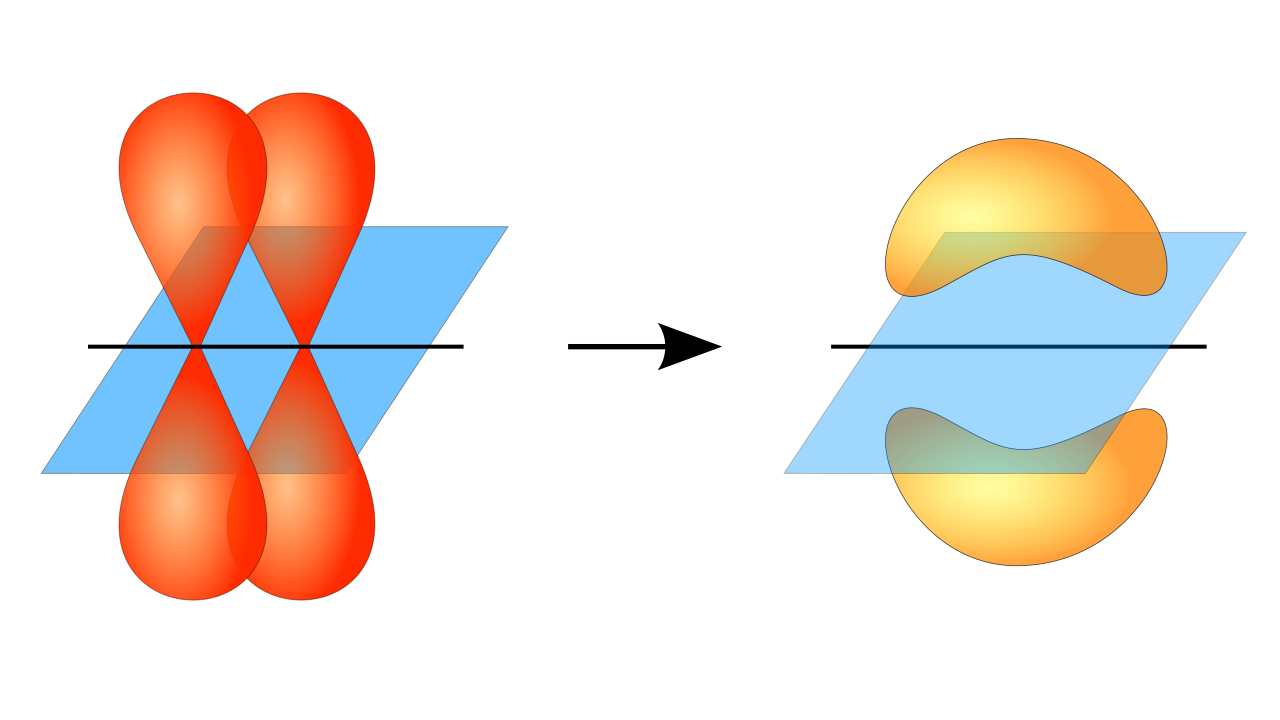
    That's a bit of a grand word, but it rings true. When I took freshman pre-med chemistry, I'd never learned quantum mechanics. I'd never heard of wave-particle duality or molecular orbital theory, I'd never seen the different shapes of the s, p, and d electron orbitals derived from Schrödinger's Equation (not that I cannot derive them for you, even now - sorry, Professor). I hadn't heard of Fermi contact affecting NMR spectrums. Really, I had a set, sensible way of thinking.
From Wikipedia: Two atomic p electron orbitals form a molecular pi bond.
    And chemistry blew all of those set images apart. You thought of electrons as dots? Nope. It's a cloud that's two things at once. I thought of molecules as having their bonded electrons in fixed places between two atoms? Guess again.
    The world was so intricate and crazy and above our current mind's understanding. There was so waiting much to be discovered.
    Soon I became obsessed and determined to study this subject. When I was introduced to organic chemistry, I found the puzzle-like aspect of the subject both enthralling and enjoyable. And working in a lab proved exciting, interesting ... and full of failure, because chemistry definitely teaches you to fail. Life lessons, I suppose.
    ***
    People say science and religion cannot coexist. Many religious people claim scientists have an anti-God agenda in promoting global warming and relative quantum mechanics and evolution. Many scientists view religious adherents as willfully ignorant, scared of both facts and truth.
    And so it's quite scary to say I'm a Christian and a scientist. Even if Christianity is what I believe and science what I do, they're both parts of me, both influence the other, and so separating them isn't possible (nor is it helpful).
    (Sidenote: I should clarify, when I speak of the two influencing the other, that I do not mean I consider the Bible a science book or science a holy word).
    The notion that the universe is nothing we can decipher, that sucks me in like a black hole. It's crazy-freaking-awesome. I don't want a God I can fit into my small box of limited understanding; in that case, there's no clearer sign he's a made-up entity of my mind.
    I want a God who leaves me wonderstruck.
    So, if the universe is so beyond our current understanding, how much more is God? How much more is his love and mercy and goodness and holiness?
    I find that exciting.
   And so chemistry and Christianity are not a conflict in my life. Both science and faith draw me closer in a dance with God (If I danced, that is). ;)
   What are your science/faith experiences?

Love,
Kelley
 

Monday, July 21, 2014

I'm a Feminist Because I'm a Misogynist

    I hate the word "woman." That's why I'm a feminist.
    Woman. Woman, she shall be called, because she was taken from man.
    Woman makes my tummy tingle and conjures up an image of someone dressed in a dim pink sheath, submissive and silent, superficial and not so smart, her hips wide for child-bearing. A lactating cow, useful property for sex and pleasing to look at.
     I'm not fond of "lady" either, since I have no desire to scream and pull my skirts away from devious little mice, and I'm just not an elegant person. I need glasses, I'm perpetually covered in cat hair, and my makeup usually consists of red rings on my face from my lab goggles.
    Call me a girl. Even if it makes me sound childlike and sheltered and in need of protection. Even though when I fail at sports or get a question wrong in chemistry, failing kind of makes sense because I'm a girl. At least a girl runs free and does what she wants.
    Just don't say I'm a woman. I'm not a doormat sex object or a child-bearing oven. I'm not your bitch.
    ***
    I hope I don't have to tell you that this is misogyny. Misogyny of the sickest, deepest kind, lodged deep in my heart and soul.
    My soul. Me. I am a humanist, a Jesus-loving feminist.
    And I hate being a "woman." I'm uncomfortable with being twenty-one, no longer really qualifying as a girl, having periods and hips far fuller than my breasts. I'm uncomfortable being thought of as a tantalizing treat.
    So. There is misogyny in me.
    Don't you see how unbelievably screwed up this is?
   ***
    But what is "woman," exactly? It's a concept that describes what I am, for the world.
    Those stupid misogynistic images? Mere connotation (which, in case you don't know, signals that our world is unbelievably screwed up. Connotation comes from somewhere).
    This, however, is the image that comes up when I search "woman" on the Internet:
Courtesy of Wikipedia.

     Naked, covered, old, young, fat and skinny. Beautiful and ungainly. Sculptured, painted, photographed. Together, they're a myriad of colors, depicting people of different races and religions and different times. Different stories, too, uniquely their own.    
    They're all people.
    These are people; they've lived. Don't you see, these are women and they are people, people who've etched themselves into many or few people's lives.
    Aren't they beautiful? And handsome? And glorious?
    Don't you see Jesus reflected in their many colors and stories?
    This picture? It's feminism.
***
    I'm a feminist because I'm a woman, and I have misogyny hiding in my darkest, most secret parts.
    Feminism says only this: I'm a woman. Because what woman means is human. Fully, deeply, intimately, intricately human.
    And, to take that one step further, if I'm a woman, I reflect Jesus.
    I will not be prescribed how to reflect Jesus based on a chromosome. He is God - God so unending, so far above what we can comprehend, facets of Her can be reflected and found in everyone and still many more left over.
     So, yeah. That's why I'm a feminist.

Love,
Kelley


Sunday, April 13, 2014

Love is A Solvent and Walls are Solutes (A Guest Post by Kate Danahy)

    The lovely Kate Danahy (also known as my twin sister) wrote a guest post for me! At just the right time, too, since I'm too busy trying not to drown during this time of thesis-paper-project-presentation-all-due-oh-my-gosh to write a halfway decent post. 
    Kate graduated early from Gordon College and currently works writing children's stories in India. She blogs at http://katedanahy.blogspot.com/, and you should definitely check it out. In her own words, she's "a globe-trotting, people-loving introvert with a heart in India, an obsession with Russian literature and Shakespeare, and an addiction to tea."
    Sidenote: I came up with the title. The second you say dissolve, I think CHEMISTRY. #Sorrynotsorry. :D

    It's easy to have an opinion about a people group or an ideology or a religion--be it gays, socialists, or Muslims--an opinion that's engraved in a marble wall, definite and sure, black and white, true.
     And then the girl whose testimony inspires you, the girl whose love for Jesus paints everything she does and even convicts you sometimes, the girl whose words about trusting God in the midst of addiction are a lifeline you hold to in a dark moment when, for the first time in years, you find yourself spiraling down into the prison of cutting that used to shackle you--when that girl comes out as a lesbian, the black and white pool together, creating gray.
     And when you travel to India, you meet the woman whose name you can't remember, the woman with her hair wrapped in a black scarf who is headmistress of a Muslim school, the woman who, if any girl drops out to get married young, tracks the family down, takes the girls back to finish their education. Her fervor for social justice, for feminism even, surpasses many Christians.
    You call other Muslim lady who makes you tea every day, sweetened with sugar and spiced with cardamom, who calls you "Katie," and giggles at everything, your friend. 
    And as your political ideology shifts dramatically left, you're never able to demonize those who believe what you used to, because for so long that was your tribe, people you love, and you know that as much as people who hold your current beliefs sometimes scoff at them, and as strongly as you disagree, Republicans and right-wingers can't be classified as ignorant, or heartless. One of your best friends, who comforted you with dark chocolate and coconut in a personal crisis, is a Republican. The people who nurtured you in childhood, who still feed your spirit weekly and daily, are right-wingers, and they love Jesus just as much as you do.
    And the wall dissolves completely.
    It's so easy to keep the lines of black and white nice and neat when you don't know people. 
    But when you reach across, when you shake their hand instead of keeping yours sanitized and dangling by your side, you find that the hand of one you thought Different is made of skin and bone and veins just like yours.
    It's so, so easy to crouch behind those stones, refusing to look up and meet their eyes, to really see them, when you don't understand them, when you're afraid of the "Other" and what it might mean for the nice, neat stones you've built into a wall around yourself. But the reality is, the idea of the "other" is unloving, a clanging cymbal blooming from fear, decaying and taking you with it. 
    When you let go of your assumptions and have tea together, your opinions--all those stones you carefully arranged into a perfectly neat wall--will crumble, and it might be scary. But it will also set you free. The truth does that, after all. 
    And then a kind of agape love is born, because you truly understand you aren't better than anyone, and together--even if you disagree on religion or politics or whatever--you can break down more walls, work for understanding and dialogue, even (as cliche and hippy-ish as it sounds), for love.

Friday, March 28, 2014

Is Time Linear?

    Whilst taking a walk to calm my overheating brain, this is actually the question that popped in my mind. And sent me into a tangle of pondering and mind racing.
    Is time linear?
    I mean, most people seem to operate under this assumption. Once something's done, it's done. Over.
    But is that true, or merely our perception?
    I think it was C.S. Lewis who wondered if all time is happening simultaneously - as in, St. Peter is always denying Jesus in that one period of time. Unfortunately, I can't find the original quote. But I find it an interesting possibility. Especially since if there is a God, He ought to be outside of time, which is not something I can exactly comprehend.
    Or is time circular? Are there infinite chances? When different choices change one thing, which changes another ... except if all of these things change, I wouldn't be me anymore. As much a some situations have sucked and my decisions have hurt, they're a part of my life. Not saying I wouldn't wish for something different, because in some cases I do, but they've still helped shape who I am, for better or worse.
    According to Wikipedia (don't deny you use it too), a lot of ancient cultures believes time was cyclical, but not Judaism of Christianity, since they believe that God created time.
    Then again, also according to Wikipedia, Kant proposed that time might just exist outside of the universe. As in, time is simply the way we process things, not real in itself. Don't ask me to comment more on that one. My head's not wrapping around it, though it's an interesting concept.
   And hey, according to Einstein and other crazy-smart people, space and time might just be the same thing: spacetime.
   Weird. And cool. And headache-inducing, but chock full of the potential to craft a good story.
   So, what about you? What do you think of this funny thing (if it is a thing) called time?

Love,
Kelley