Last Friday night I enjoyed the company of one of my best friends, Rosalie Jiang. Somehow, in between our reminiscing over college and discussing our quarter-life crises, we landed on the topic of innocence.
And she said something very wise and beautiful, especially for this very visual learner, so I thought I'd share it for you to see.
Innocence, it's often thought of as fresh-fallen snow. And snow shines most brightly in the sun, which, you know, is exactly what can melt it. Innocence shines most brightly in the face of what might destroy it.
I think of people like Anne Frank, who somehow kept optimism about humanity even as she hid from the people trying to destroy her family.
I think of children, who have to ask questions like "what is war?" and "what is death?"
I think of Jesus, who was God and saw everything, yet still wept at death.
I also think of Adam and Eve, who ate from the tree of knowledge. As someone who loves learning, I'm always bothered by why knowledge was forbidden.
Except, it wasn't simply "The Tree of Knowledge." It was "The Tree of the Knowledge of Good and Evil."
And so, perhaps, the Garden involves the loss of innocence - the deep knowing of evil.
Fine, okay. But what is innocence?
Well, I don't have a concrete answer, but that's okay because I prefer the abstract.
I do think innocence is often shortchanged; we view it as either naiveté or virginity. However, if innocence is a virtue, I don't think it can be ignorant like naiveté. Nor can it be the rigid sexual 'rule' of virginity - Adam and Eve were married and innocent.
Innocence, maybe, is an elusive essence, found in the unblemished love of mother for child, in the hope of a bride, and in the kindness of a small child offering you flowers. Maybe innocence is found the belief that God can use goodness and beauty to save the world.
Whatever it is, innocence is subversive. When violence seems the easiest action, when bitter retorts the best response, maybe we reclaim a bit of that shining innocence when we choose peace and love.
Maybe we reclaim innocence when we see the reality of our abuse and say no. When we leave because this is not how it should be. Maybe innocence is seeing things as they should be.
Maybe truth is not condemnation. Maybe the truth is innocent.
Innocence shines most brightly in the face of what might destroy it.
Maybe innocence is in the image of God. Maybe it's still hidden in us tired seeking souls.
Maybe we'll all shine our brightest in the face of what can destroy us.
Tuesday, September 9, 2014
Friday, September 5, 2014
How Chemistry Influences My Faith
There's a similar expression that crosses most people's faces when I tell them I study organic chemistry, as if the question are-you-smart-or-just-crazy flashes through their mind (for the record, the answer is crazy).
So I typically reply "I love chemistry." And I mean it, but sometimes my claim comes with no reason or feeling, like I've buried them beneath my fears of failure or rejection or my enjoyable but chemistry-free times this summer. I'm also secretly afraid that I'm just fooling myself thinking that I can actually do grad school in orgo (Ha, according to TA training, this is called "Impostor Syndrome").
But now that I'm enveloped in organic chemistry problem sets again (at last! No, seriously, I find them fun, if difficult), I've been re-discovering why I like the subject.
Mystery.
That's a bit of a grand word, but it rings true. When I took freshman pre-med chemistry, I'd never learned quantum mechanics. I'd never heard of wave-particle duality or molecular orbital theory, I'd never seen the different shapes of the s, p, and d electron orbitals derived from Schrödinger's Equation (not that I cannot derive them for you, even now - sorry, Professor). I hadn't heard of Fermi contact affecting NMR spectrums. Really, I had a set, sensible way of thinking.
And chemistry blew all of those set images apart. You thought of electrons as dots? Nope. It's a cloud that's two things at once. I thought of molecules as having their bonded electrons in fixed places between two atoms? Guess again.
The world was so intricate and crazy and above our current mind's understanding. There was so waiting much to be discovered.
Soon I became obsessed and determined to study this subject. When I was introduced to organic chemistry, I found the puzzle-like aspect of the subject both enthralling and enjoyable. And working in a lab proved exciting, interesting ... and full of failure, because chemistry definitely teaches you to fail. Life lessons, I suppose.
And so it's quite scary to say I'm a Christian and a scientist. Even if Christianity is what I believe and science what I do, they're both parts of me, both influence the other, and so separating them isn't possible (nor is it helpful).
(Sidenote: I should clarify, when I speak of the two influencing the other, that I do not mean I consider the Bible a science book or science a holy word).
The notion that the universe is nothing we can decipher, that sucks me in like a black hole. It's crazy-freaking-awesome. I don't want a God I can fit into my small box of limited understanding; in that case, there's no clearer sign he's a made-up entity of my mind.
I want a God who leaves me wonderstruck.
So, if the universe is so beyond our current understanding, how much more is God? How much more is his love and mercy and goodness and holiness?
I find that exciting.
And so chemistry and Christianity are not a conflict in my life. Both science and faith draw me closer in a dance with God (If I danced, that is). ;)
What are your science/faith experiences?
Love,
Kelley
So I typically reply "I love chemistry." And I mean it, but sometimes my claim comes with no reason or feeling, like I've buried them beneath my fears of failure or rejection or my enjoyable but chemistry-free times this summer. I'm also secretly afraid that I'm just fooling myself thinking that I can actually do grad school in orgo (Ha, according to TA training, this is called "Impostor Syndrome").
But now that I'm enveloped in organic chemistry problem sets again (at last! No, seriously, I find them fun, if difficult), I've been re-discovering why I like the subject.
Mystery.
That's a bit of a grand word, but it rings true. When I took freshman pre-med chemistry, I'd never learned quantum mechanics. I'd never heard of wave-particle duality or molecular orbital theory, I'd never seen the different shapes of the s, p, and d electron orbitals derived from Schrödinger's Equation (not that I cannot derive them for you, even now - sorry, Professor). I hadn't heard of Fermi contact affecting NMR spectrums. Really, I had a set, sensible way of thinking.
| From Wikipedia: Two atomic p electron orbitals form a molecular pi bond. |
The world was so intricate and crazy and above our current mind's understanding. There was so waiting much to be discovered.
Soon I became obsessed and determined to study this subject. When I was introduced to organic chemistry, I found the puzzle-like aspect of the subject both enthralling and enjoyable. And working in a lab proved exciting, interesting ... and full of failure, because chemistry definitely teaches you to fail. Life lessons, I suppose.
***
People say science and religion cannot coexist. Many religious people claim scientists have an anti-God agenda in promoting global warming and relative quantum mechanics and evolution. Many scientists view religious adherents as willfully ignorant, scared of both facts and truth.And so it's quite scary to say I'm a Christian and a scientist. Even if Christianity is what I believe and science what I do, they're both parts of me, both influence the other, and so separating them isn't possible (nor is it helpful).
(Sidenote: I should clarify, when I speak of the two influencing the other, that I do not mean I consider the Bible a science book or science a holy word).
The notion that the universe is nothing we can decipher, that sucks me in like a black hole. It's crazy-freaking-awesome. I don't want a God I can fit into my small box of limited understanding; in that case, there's no clearer sign he's a made-up entity of my mind.
I want a God who leaves me wonderstruck.
So, if the universe is so beyond our current understanding, how much more is God? How much more is his love and mercy and goodness and holiness?
I find that exciting.
And so chemistry and Christianity are not a conflict in my life. Both science and faith draw me closer in a dance with God (If I danced, that is). ;)
What are your science/faith experiences?
Love,
Kelley
Labels:
Chemistry,
Faith,
Fear,
God,
Imagination,
Organic Chemistry,
Science
Wednesday, September 3, 2014
Stories That Changed My Life
Okay, I'm a ravenous fiction addict, so... because I'm short on time and long on problem sets and procrastination, here's a list of ten books whose stories have continued to haunt/inspire me long after I finished reading them. Basically, they're novels that have changed my life.
1. Crime and Punishment
You don't want to know what I would do for half the writing mastery Fyodor Dostoevsky possessed. Seriously, who else can weave the story of an axe murderer's existential crisis under the guidance of a saintly prostitute, and keep it terribly beautiful? If you're filled with hatred of humanity, this story will both affirm your rage while stirring your hope in redemption.
Quote: “Taking a new step, uttering a new word, is what people fear most.”
2. Anna Karenina
Russian Literature is where it's at, my friends. Ahem. Anyhow, Tolstoy himself esteemed Anna Karenina above War and Peace (which you should also read). The magnificent characters come across so intricately human you feel you could meet Anna or Lenin if you walked out your door. No human emotion and thought was too silly, wicked, idealistic, or noble for Tolstoy to record, and so I couldn't help but identify with all of his characters, noble or base. Plus, there's a portion of the story Tolstoy writes from a dog's the point of view, so all animal enthusiasts will have one more reason to love Anna Karenina.
Quote: “All the girls in the world were divided into two classes: one class included all the girls in the world except her, and they had all the usual human feelings and were very ordinary girls; while the other class - herself alone - had no weaknesses and was superior to all humanity.”
3. Les Miserables
What draws me to mercy? What draws me to showing compassion? Victor Hugo's iconic image of the Bishop of Digne freeing the thief Jean Valjean and giving him his most valuable items. The Gospel of Jesus is acted out through the Bishop, and his impact on Valjean's life is inspiring beyond words.
Quote: "Before him he saw two roads, both equally straight; but he did see two; and that terrified him--he who had never in his life known anything but one straight line. And, bitter anguish, these two roads were contradictory.”
4. Waiting for the Barbarians
J.M. Coetzee's Nobel Prize winning novel is written in an enchantingly simple yet poetic prose. Too bad that's all that you'll find enchanting. A story set in no discernible time nor discernible location, where most characters have no names, Waiting for the Barbarians examines a man's struggle for morality as fear of the indigenous barbarians leads the Empire to dehumanize anyone who opposes them. It's graphically violent, graphically sexual, and above all graphically human. I've never had a novel make me cry and scream and cheer through my tears in one page. Read it when you need your heart broken.
Quote: "‘Look!’ I shout. ‘We are the great miracle of creation! But from some blows this miraculous body cannot repair itself! How—!’ Words fail me. ‘Look at these men!’ I recommence. ‘Men!’”
5. Frankenstein
Besides that Victor Frankenstein is a chemist (hehe), Mary Shelley's masterpiece has made me re-examine everything from my purpose in creating, my view of others, compassion and justice, to my view of God. Grim but so, so necessary - and convicting.
Quote: "'Accursed creator! Why did you form a monster so hideous that even you turned from me in disgust? God, in pity, made man beautiful and alluring, after his own image; but my form is a filthy type of yours, more horrid even from the very resemlance. Satan had his companions, fellow-devils, to admire and encourage him; but I am solitary and abhorred.'"

6. Harry Potter
I didn't read J.K. Rowling's epic series until last year because the whole witchcraft thing weirded me out. Then I read a story of love and good vs. evil in a world we all want to join (you can admit it). This story is peppered with stunningly complex characters like Severus Snape and Sirius Black, whom you love despite how uncomfortable their actions make you. Plus, Hermione is one of the greatest female characters of all time. She's a genius who shows you don't have to be kickass to get stuff done (not that kickass is bad, but, well, I'm just not). It'll rekindle your belief in good again.
Quote: “Of course it is happening inside your head, Harry, but why on earth should that mean that it is not real?”
7. The Lord of the Rings
As a writer of fantasy, of course I had to include Tolkien's renowned tale. Besides friendship and breathtaking world building (I am forever dissatisfied that we don't know much about Beluthiel's cats) Smeagol's fight with Gollum's very real addiction to the Ring transforms him from a pitiful character to someone most addicts can all identify with, however uncomfortable that may make us. Plus, the ending will leave you aching.
Quote - "Not all those who wander are lost."

8. The Chronicles of Narnia
My introduction to the wonderful world of fantasy began with C.S. Lewis's The Magician's Nephew, and I've yet to stop obsessing. Theological musings mixed with children's stories; how can it get better? And I found myself, like the many marvelous characters who undergo drastic change as the books progress, altered after reading these stories.
Quote - “'It is very true. But even a traitor may mend. I have known one who did.' And he looked very thoughtful.”
9. The Master and Margarita
I've returned the list to Russian Literature, surprise. Mikhail Bulgakov's novel is bizarre and satirical, two things I don't normally enjoy. And I didn't enjoy them in The Master and Margarita, either. But I've kept coming back to this novel and all the questions it raised in the years following. I mean, when Satan's visit atheistic Russia becomes entangled with a married woman who wants to find her unjustly imprisoned lover, who happens to be writing a novel based on Jesus' crucifixion, masterful (pun intended) musings on theology, fantasy, Russian literature, and mercy are bound to occur.
Plus there's this fantastic quote: “Follow me, reader! Who told you that there is no true, faithful, eternal love in this world! May the liar's vile tongue be cut out! Follow me, my reader, and me alone, and I will show you such a love!”
10. A Voice in the Wind
Francine Rivers' novel is technically classified as Christian literature, but I think that people of most religious beliefs could enjoy the story of a Jewish slave girl in Rome, who falls in love with her wildchild mistress's brother. The character development, especially in Julia Valerian, is flawless. Flawless, I tell you. I've never been so desperate over a character's choices.
Quote: “'Can you see air you breathe? Can you see the force that moves the tides or changes the seasons or sends the birds to a winter haven?' Her eyes welled. 'Can Rome with all its knowledge be so foolish? Oh Marcus, you can't carve God in stone. You can't limit him to a temple. You can't imprison him on a mountaintop. Heaven is his throne; earth, his footstool. Everything you see is his. Empires will rise and empires will fall. Only God prevails.'"
Really, the list is a lot longer, but I stopped at ten. Now it is your turn, mwahaha - and you don't have to stop at ten, even! What stories have changed your life?
Love,
Kelley
1. Crime and Punishment
You don't want to know what I would do for half the writing mastery Fyodor Dostoevsky possessed. Seriously, who else can weave the story of an axe murderer's existential crisis under the guidance of a saintly prostitute, and keep it terribly beautiful? If you're filled with hatred of humanity, this story will both affirm your rage while stirring your hope in redemption.
Quote: “Taking a new step, uttering a new word, is what people fear most.”
2. Anna Karenina
Russian Literature is where it's at, my friends. Ahem. Anyhow, Tolstoy himself esteemed Anna Karenina above War and Peace (which you should also read). The magnificent characters come across so intricately human you feel you could meet Anna or Lenin if you walked out your door. No human emotion and thought was too silly, wicked, idealistic, or noble for Tolstoy to record, and so I couldn't help but identify with all of his characters, noble or base. Plus, there's a portion of the story Tolstoy writes from a dog's the point of view, so all animal enthusiasts will have one more reason to love Anna Karenina.
Quote: “All the girls in the world were divided into two classes: one class included all the girls in the world except her, and they had all the usual human feelings and were very ordinary girls; while the other class - herself alone - had no weaknesses and was superior to all humanity.”
3. Les Miserables
What draws me to mercy? What draws me to showing compassion? Victor Hugo's iconic image of the Bishop of Digne freeing the thief Jean Valjean and giving him his most valuable items. The Gospel of Jesus is acted out through the Bishop, and his impact on Valjean's life is inspiring beyond words.
Quote: "Before him he saw two roads, both equally straight; but he did see two; and that terrified him--he who had never in his life known anything but one straight line. And, bitter anguish, these two roads were contradictory.”
4. Waiting for the Barbarians
Quote: "‘Look!’ I shout. ‘We are the great miracle of creation! But from some blows this miraculous body cannot repair itself! How—!’ Words fail me. ‘Look at these men!’ I recommence. ‘Men!’”
Besides that Victor Frankenstein is a chemist (hehe), Mary Shelley's masterpiece has made me re-examine everything from my purpose in creating, my view of others, compassion and justice, to my view of God. Grim but so, so necessary - and convicting.
Quote: "'Accursed creator! Why did you form a monster so hideous that even you turned from me in disgust? God, in pity, made man beautiful and alluring, after his own image; but my form is a filthy type of yours, more horrid even from the very resemlance. Satan had his companions, fellow-devils, to admire and encourage him; but I am solitary and abhorred.'"
6. Harry Potter
I didn't read J.K. Rowling's epic series until last year because the whole witchcraft thing weirded me out. Then I read a story of love and good vs. evil in a world we all want to join (you can admit it). This story is peppered with stunningly complex characters like Severus Snape and Sirius Black, whom you love despite how uncomfortable their actions make you. Plus, Hermione is one of the greatest female characters of all time. She's a genius who shows you don't have to be kickass to get stuff done (not that kickass is bad, but, well, I'm just not). It'll rekindle your belief in good again.
Quote: “Of course it is happening inside your head, Harry, but why on earth should that mean that it is not real?”
7. The Lord of the Rings
As a writer of fantasy, of course I had to include Tolkien's renowned tale. Besides friendship and breathtaking world building (I am forever dissatisfied that we don't know much about Beluthiel's cats) Smeagol's fight with Gollum's very real addiction to the Ring transforms him from a pitiful character to someone most addicts can all identify with, however uncomfortable that may make us. Plus, the ending will leave you aching.
Quote - "Not all those who wander are lost."
8. The Chronicles of Narnia
My introduction to the wonderful world of fantasy began with C.S. Lewis's The Magician's Nephew, and I've yet to stop obsessing. Theological musings mixed with children's stories; how can it get better? And I found myself, like the many marvelous characters who undergo drastic change as the books progress, altered after reading these stories.
Quote - “'It is very true. But even a traitor may mend. I have known one who did.' And he looked very thoughtful.”
9. The Master and Margarita
I've returned the list to Russian Literature, surprise. Mikhail Bulgakov's novel is bizarre and satirical, two things I don't normally enjoy. And I didn't enjoy them in The Master and Margarita, either. But I've kept coming back to this novel and all the questions it raised in the years following. I mean, when Satan's visit atheistic Russia becomes entangled with a married woman who wants to find her unjustly imprisoned lover, who happens to be writing a novel based on Jesus' crucifixion, masterful (pun intended) musings on theology, fantasy, Russian literature, and mercy are bound to occur.
Plus there's this fantastic quote: “Follow me, reader! Who told you that there is no true, faithful, eternal love in this world! May the liar's vile tongue be cut out! Follow me, my reader, and me alone, and I will show you such a love!”
10. A Voice in the Wind
Francine Rivers' novel is technically classified as Christian literature, but I think that people of most religious beliefs could enjoy the story of a Jewish slave girl in Rome, who falls in love with her wildchild mistress's brother. The character development, especially in Julia Valerian, is flawless. Flawless, I tell you. I've never been so desperate over a character's choices.
Quote: “'Can you see air you breathe? Can you see the force that moves the tides or changes the seasons or sends the birds to a winter haven?' Her eyes welled. 'Can Rome with all its knowledge be so foolish? Oh Marcus, you can't carve God in stone. You can't limit him to a temple. You can't imprison him on a mountaintop. Heaven is his throne; earth, his footstool. Everything you see is his. Empires will rise and empires will fall. Only God prevails.'"
Really, the list is a lot longer, but I stopped at ten. Now it is your turn, mwahaha - and you don't have to stop at ten, even! What stories have changed your life?
Love,
Kelley
Wednesday, August 27, 2014
What If I Lose My Mind?
I'm starting grad school, and in between the excitement of new friends and teaching for the first time in my life, and the stress of not getting lost or forgetting what to do and when to do it, there's a shadow lurking in my heart.
It beats harder and darker whenever I acknowledge it. I'm scared of this secret, so maybe if I sure it here, it will lose some of its power?
I'm scared I'll lose my mind.
Look, it's been what? Eight months since I started recovering from extreme depression and anxiety? I'm blown away and so grateful to my therapists, family and friends when I think of all that's happened since. I'm not the same avoidant, voiceless personality I was a year ago.
But there's still that memory that haunts me, a wisp of a timid girl horror-struck by dangerous life. She shows up when I'm tired and hungry, when I have headaches or am overwhelmed at the disorienting orientations. And she locks me in my old habits, hijacks me in the fear that she's back and what if she returns for good?
Now, recovery takes time, maybe a lifetime. That's helpful to know, sure, but it doesn't make the relapses any more tolerable.
And now I'm entering the reportedly stressful first year of a PhD program in the compelling but dizzying subject of organic chemistry.
I'd be lying to say I'm not terrified of screwing up. Not so much in terms of schoolwork - that'll happen, it happens to everyone - but in terms of personal issues. Will I return to my paralyzing fears, like a dog to its vomit?
Probably. Not all of it is my choice, after all. Some is instinct.
I suppose climbing back up, returning and trying to do better rather than accepting the status quo are what I have to aim for. Because aiming for perfection sucks. But aiming for recovery, that I think I can do.
I follow a God who loves resurrection, after all. I honestly don't think I'd follow Him if He didn't.
Obviously, I love the idea of resurrection.
But practicing resurrection: it's hard. It's freaking hard to get back up when you've slipped and smashed around on the ground before everyone you know.
Resurrection says pride has to go. Yes, I have a problem. I've crashed and burned, and now I rise by the power and love of God and the people in my life.
Resurrection says it's time to escape the hiding habits I've developed (food and isolation and lying),; it's time to walk out of those tombs; it's time to show I'm alive.
Resurrection says I love you so much I will conquer even the inevitable death for you.
In the concrete, resurrection means walking up to the grad student I froze in front of and smiling.
Resurrection.
There's a song I listen to every August, when the first dry air and cool mornings appear and feel almost like hope. The quiet mornings, before the day heats back up, that tantalize the approach of autumn. Autumn, when the new begins and the school year resurrects.
So I listen to The Rend Collective's Experiments "Desert Soul."
I'm lost without Your create spark in me
I'm dead inside unless Your resurrection speaks.
Have a listen, if you wish. And whatever needs resurrection in your life, I pray it for you, reader and friend.
Love,
Kelley
It beats harder and darker whenever I acknowledge it. I'm scared of this secret, so maybe if I sure it here, it will lose some of its power?
I'm scared I'll lose my mind.
Look, it's been what? Eight months since I started recovering from extreme depression and anxiety? I'm blown away and so grateful to my therapists, family and friends when I think of all that's happened since. I'm not the same avoidant, voiceless personality I was a year ago.
But there's still that memory that haunts me, a wisp of a timid girl horror-struck by dangerous life. She shows up when I'm tired and hungry, when I have headaches or am overwhelmed at the disorienting orientations. And she locks me in my old habits, hijacks me in the fear that she's back and what if she returns for good?
Now, recovery takes time, maybe a lifetime. That's helpful to know, sure, but it doesn't make the relapses any more tolerable.
And now I'm entering the reportedly stressful first year of a PhD program in the compelling but dizzying subject of organic chemistry.
I'd be lying to say I'm not terrified of screwing up. Not so much in terms of schoolwork - that'll happen, it happens to everyone - but in terms of personal issues. Will I return to my paralyzing fears, like a dog to its vomit?
Probably. Not all of it is my choice, after all. Some is instinct.
I suppose climbing back up, returning and trying to do better rather than accepting the status quo are what I have to aim for. Because aiming for perfection sucks. But aiming for recovery, that I think I can do.
I follow a God who loves resurrection, after all. I honestly don't think I'd follow Him if He didn't.
Obviously, I love the idea of resurrection.
But practicing resurrection: it's hard. It's freaking hard to get back up when you've slipped and smashed around on the ground before everyone you know.
Resurrection says pride has to go. Yes, I have a problem. I've crashed and burned, and now I rise by the power and love of God and the people in my life.
Resurrection says it's time to escape the hiding habits I've developed (food and isolation and lying),; it's time to walk out of those tombs; it's time to show I'm alive.
Resurrection says I love you so much I will conquer even the inevitable death for you.
In the concrete, resurrection means walking up to the grad student I froze in front of and smiling.
Resurrection.
There's a song I listen to every August, when the first dry air and cool mornings appear and feel almost like hope. The quiet mornings, before the day heats back up, that tantalize the approach of autumn. Autumn, when the new begins and the school year resurrects.
So I listen to The Rend Collective's Experiments "Desert Soul."
I'm lost without Your create spark in me
I'm dead inside unless Your resurrection speaks.
Have a listen, if you wish. And whatever needs resurrection in your life, I pray it for you, reader and friend.
Love,
Kelley
Saturday, August 23, 2014
Down with the Progressive Police.
For all the progressive talks of "inclusivity," progressives are often as exclusive as the conservatives they like to demonize.
I realize I'm probably going to take some heat for this. And my title is pretty combative, for which...I'm not sorry.
I've had it with the progressive hypocrisy. I'll only apologize if I've failed to consider a perspective, so if I go wrong here, let me know how and why you're concerned.
I'm writing this because I'm growing very troubled by the progressive policing I see happening on the blogosphere and on Twitter.
Examples:
You can't be a feminist if you're a man (why? Because they can't fully understand what it's like to be discriminated against? Do we really want to draw discriminatory lines like this? If they actually, truly respect a woman as fully human - none of that "equal but different roles balderdash - I want them to call themselves a feminist. The label "feminist" has been too much maligned as is).
You can't be a feminist if you're pro-life (Because if one acknowledges a woman as fully human, they must suddenly realize that pro-choice is their only option. There's no room for growth. You believe XYZ so you must believe ABC, or you don't believe XYZ. Yeah, no).
You can't talk about race if you're white (This one is kinda true. You don't get to say you know how it feels to be a racial minority or discriminated against. You better shut up and listen to people of color before opening your mouth. But you can humbly participate in raising the voices of those who've been oppressed by racism, which is, I suppose, technically talking about race, just in a different manner).
It's not my job to educate you on LGBTQ/woman's/race issues (so how do others find out about this stuff, hmm?).
Don't tell me to be nice. That's tone policing! (Ah, because kindness has nothing to do with love. Funny how those supposedly narrow conservatives advocating "love the sinner, hate the sin" use the exact same reasoning).
Progressive Christians in particular love to talk about inclusivity. "The kingdom of God is controversial in whom it lets in" and all.
Too bad the more progressive/post-evangelical Christians (which includes myself, I suppose) are incredibly hypocritical here.
We love to cast down the sexists/racists/bigots. Good. Ain't no place for that in God's kingdom.
And then we kick them when they are down. Eh, I don't think that's in God's kingdom either.
But, for examples, see:
1). Exultations over Mark Driscoll's demise, which, though he deserved to be reprimanded/removed for his horrific bigotry, he did not need many people who don't know him offering their opinions, judgements, and castigations. Discussing the systems that allowed his problems to continue is completely different than personal attacks and speculations.
2). People shaming pacifist Brian Zhand's initial comments on Ferguson. Rather than expressing caution about the implications of what he said, people immediately assumed he wanted to silence the outrage and decided Twitter was the loving, Jesusy means to demonize him.
STOP.
I'm worried that Christians arguing for more inclusivity are, in fact, becoming as hostile as those they claimed to be different from. Except they're trading focus on personal sins like lust for fashionable, systematic sins like bigotry.
We will be known as his disciples by our love. That's it. Love! Don't you see?
Love involves calling out stupid shit. Love involves keeping out harmful ideas. But love doesn't involve public shaming techniques that only serve to draw more barriers to exclude more people.
Please, for the love of God himself, see people as the very image of God around you. Please, for the love of God himself, try to assume good intent when you're inquiring about a questionable statement.
I'm just as guilty of this as then next person. We all need to stop.
I really am starting to suspect that assuming malevolence is pure evil. Maybe I'm wrong. Maybe I was mean in this article; I don't know. I was definitely more direct and harsh than normal.
Where do we go from here? How do we stop judging and start loving? Am I missing something here, being judgmental myself, or just plain wrong?
Let me know.
Love,
Kelley
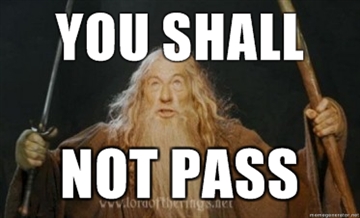
| You shall not pass because I'm assuming you have bad intent. |
I've had it with the progressive hypocrisy. I'll only apologize if I've failed to consider a perspective, so if I go wrong here, let me know how and why you're concerned.
I'm writing this because I'm growing very troubled by the progressive policing I see happening on the blogosphere and on Twitter.
Examples:
You can't be a feminist if you're a man (why? Because they can't fully understand what it's like to be discriminated against? Do we really want to draw discriminatory lines like this? If they actually, truly respect a woman as fully human - none of that "equal but different roles balderdash - I want them to call themselves a feminist. The label "feminist" has been too much maligned as is).
You can't be a feminist if you're pro-life (Because if one acknowledges a woman as fully human, they must suddenly realize that pro-choice is their only option. There's no room for growth. You believe XYZ so you must believe ABC, or you don't believe XYZ. Yeah, no).
You can't talk about race if you're white (This one is kinda true. You don't get to say you know how it feels to be a racial minority or discriminated against. You better shut up and listen to people of color before opening your mouth. But you can humbly participate in raising the voices of those who've been oppressed by racism, which is, I suppose, technically talking about race, just in a different manner).
It's not my job to educate you on LGBTQ/woman's/race issues (so how do others find out about this stuff, hmm?).
Don't tell me to be nice. That's tone policing! (Ah, because kindness has nothing to do with love. Funny how those supposedly narrow conservatives advocating "love the sinner, hate the sin" use the exact same reasoning).
Progressive Christians in particular love to talk about inclusivity. "The kingdom of God is controversial in whom it lets in" and all.
Too bad the more progressive/post-evangelical Christians (which includes myself, I suppose) are incredibly hypocritical here.
We love to cast down the sexists/racists/bigots. Good. Ain't no place for that in God's kingdom.
And then we kick them when they are down. Eh, I don't think that's in God's kingdom either.
But, for examples, see:
1). Exultations over Mark Driscoll's demise, which, though he deserved to be reprimanded/removed for his horrific bigotry, he did not need many people who don't know him offering their opinions, judgements, and castigations. Discussing the systems that allowed his problems to continue is completely different than personal attacks and speculations.
2). People shaming pacifist Brian Zhand's initial comments on Ferguson. Rather than expressing caution about the implications of what he said, people immediately assumed he wanted to silence the outrage and decided Twitter was the loving, Jesusy means to demonize him.
STOP.
I'm worried that Christians arguing for more inclusivity are, in fact, becoming as hostile as those they claimed to be different from. Except they're trading focus on personal sins like lust for fashionable, systematic sins like bigotry.
We will be known as his disciples by our love. That's it. Love! Don't you see?
| Yes, the Beatles had it right. All you need is love... |
Please, for the love of God himself, see people as the very image of God around you. Please, for the love of God himself, try to assume good intent when you're inquiring about a questionable statement.
| LOVELOVELOVELOVELOVE! |
I'm just as guilty of this as then next person. We all need to stop.
I really am starting to suspect that assuming malevolence is pure evil. Maybe I'm wrong. Maybe I was mean in this article; I don't know. I was definitely more direct and harsh than normal.
Where do we go from here? How do we stop judging and start loving? Am I missing something here, being judgmental myself, or just plain wrong?
Let me know.
Love,
Kelley
Subscribe to:
Posts (Atom)