Sunday, August 9, 2015

Stop Pontificating on Abortion

***This is not an article arguing for either the pro-choice or the pro-life side. This is an article asking some complicated questions about abortion that we can't answer, and some we won't answer, prompted by a barrage of myopic pro-life and pro-choice articles I've read.***

    I'd like to remind those debating about abortion of one simple fact:
    You don't know when life begins.
    If you want to argue that life starts at conception, what do you do with identical twins like me? Did God just throw two souls into one egg? Or am I just one half of a soul to you? And if you don't believe in God yet believe life begins at conception, seriously, how do you make sense of my existence?
    Moreover, what do you do with human chimeras? Were these twins two people, then one died, and God just let that one's cells be absorbed into the other? Or are they two souls in one person? If you're not a believer in God, seriously: what do you say?
    What do you say about the millions of zygotes frozen in time?
    What do you say about in-vitro efforts? Are these people selfishly risking someone's life for their own desires to have a kid - really?
    What do you say about the spontaneous abortions that end a pregnancy within days of conception - whose frequency, for the record, the birth control you usually oppose lessens?
    What do you say about the fetuses who, tragically, don't have a brain? Were they ever alive?
    Where is life, as a matter of fact? Is it in the brain? Is it consciousness? Have you considered the varying degrees of consciousness that all animals have, yet you eat them?
     Is life in the soul, if you believe in souls? Again, when does the soul enter your body?
     Now, if you don't believe that life begins until a baby is born, what do you do with late-term abortions whose babies can sometimes be born alive?
     What do you do with the fact that babies can be born earlier and earlier due to increasing medical technology?
     Okay. The point is this:
     You don't know when life begins.

     "We must therefore protect anything that can be life!" is an understandable conclusion. Except you're then faced with how we don't protect life once it's born, with our society's permitting of verbal abuse and sexism and classism and racism and LGBTQ+ bigotry, etc. Plus, I'm betting precious few of you have adopted an unwanted child, and many of you view unmarried sex as shameful. And if you believe in hell, what if the baby you forced to be born grows up to reject whatever god you hold?
    Okay, but two wrongs don't make a right.
    Still, you then must acknowledge - I want to hear you pro-lifers answer this - that you are forcing a woman whose life has definitely begun to have her body rearranged for nine months, to endure a discrimination and invasion of privacy. You are taking away her bodily autonomy, and if you are a man, I would also like to hear you admit that this is something your sex has done to women throughout history in a variety of ways.
    Because on both sides of the debate, a body is torn apart. Pregnancy is no easy feat - it's painful and a woman's organs are actually rearranged in her body and sometimes this is, you know, dangerous.
     If you want to go through this, yay. But how can you command someone to go through this if she doesn't want to?
    And obviously, in abortion, I want to hear pro-choicers answer that, yes, a fetus's organs are torn apart, and there is a possibility that this fetus - whose life may or may not have begun - can feel pain. During abortion, you do risk taking someone helpless's bodily autonomy away.
    So: is it moral to risk your life for someone who may or may not yet exist? And is it moral to force someone to do this? And is it moral to pontificate and shame the experience of marginalized women who made hard choices, either for or against aboriton?

    These are serious morality and metaphysical questions here, and these cannot be answered in laws or blogs or tweets.
    So no, once again, I'm not arguing for or against abortion here. I'm simply saying that you need to acknowledge the limits of your knowledge and the implication of your beliefs, and blogs and tweets do not accomplish this (including this post, since I've never experienced anything like this).
    So please stop pontificating. Please listen and learn, with compassion and empathy.
    Because abortion is just a name for a hard situation that involves real people.
    Thank you.
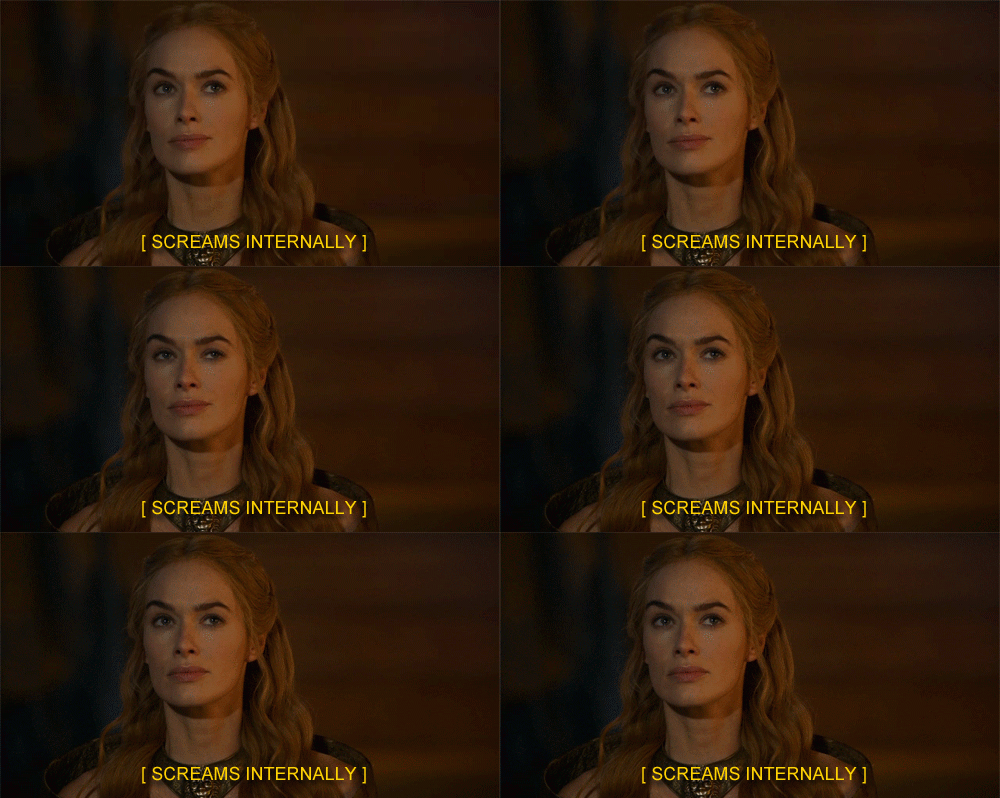
SCREAMS EXTERNALLY

Love,
Kelley
 

Saturday, July 18, 2015

Let's Be Disney Protagonists

    "Drive them from our shore!
    They're not like you and me,
    which means they must be evil!
    Let us sound the drums of war!
    They're savages! Savages!
    Barely even human!"
    -"Savages," Pocahontas

    This summer I've been re-watching my favorite Disney (mostly princess) movies. While every story is rich to me (magic, abuse survivors in Snow White and Cinderella, classism in Sleepy Beauty, cute animals!), many movies seems to have a theme of "otherness."
    See, most Disney heroes and heroines don't fit in:
    Aladdin is a street urchin who affirms his worth despite his poverty,
    Jasmine, Mulan, Merida, and Meg don't want to be playthings for men,
    Cinderella and Snow White are abused,
    Aurora, Phillip, and Hercules scorn riches and fame for the people they love,
    Ariel ignores her father's racism for Eric,
    Tiana is a working woman,
    Belle doesn't care to fit in, and, moreover, has compassion on the self-destructive,
    Esmeralda and Pocahontas belong to persecuted peoples,
    Tarzan is actually a different species from his family,
    Simba is haunted by his traumatic past, and
    Anna, Elsa, Quasimodo, and Rapunzel have been kept hidden from the world since childhood.
 
    Yet it's these Others who destroy their worlds' views of class, race, abuse, and goodness.
    Disney movies tell us that what is in our hearts matters more than our differences.
    Yes, even the older Disney stories. The wealthy stepsisters in Cinderella, and the beautiful queen in Snow White, lose because they have no kindness or compassion. In a sense, these princesses are saved by their own kindness and good-hearts - not their looks.
    And yet, how often do we forget this? Really, it's like us adults who grew up on a diet of Disney have forgotten this important lesson.
    Look at the oppression of black males in American society. Look at Franklin Graham's call to stop Muslim immigration, or Charisma News' obsession with the "threat" posed by Muslims and LGBTQ+ people. In fact, look up the statistics on LGBTQ+ homelessness and suicide rates. Try to pretend our society hasn't become like the bigoted Englishmen who belt out "Savages."
    Also, try to pretend the lyrics to "Kill the Beast" aren't very applicable to modern America.

    "We don't like what we don't
    Understand, and in fact it scares us,
    And this monster is mysterious at least.
    Bring your guns, bring your knives,
    Save your children and your wives!
    Save your village and our lives!
    Let's kill the beast!"
    - "Kill the Beast," Beauty and the Beast
   
    Because not only does this song emphasize our tendency to ostracize anything outside the norm, it also shows us what that norm is: trigger-happy manhood. The "we" doesn't include females (or anyone gender-nonconforming), yet, ironically, the heroine Belle is the only one who actually does understand. This idea is also explored in Mulan's  epic "I'll Make a Man Out of You," in which the best "man" turns out to be the woman warrior Mulan.  
    Moreover, last week I re-watched The Hunchback of Notre Dame. I was struck by how much Claude Frollo's persecution of the Romani in the name of purity reminded me of the way my evangelical tradition often treats LGBTQ+ people.
    Yet.
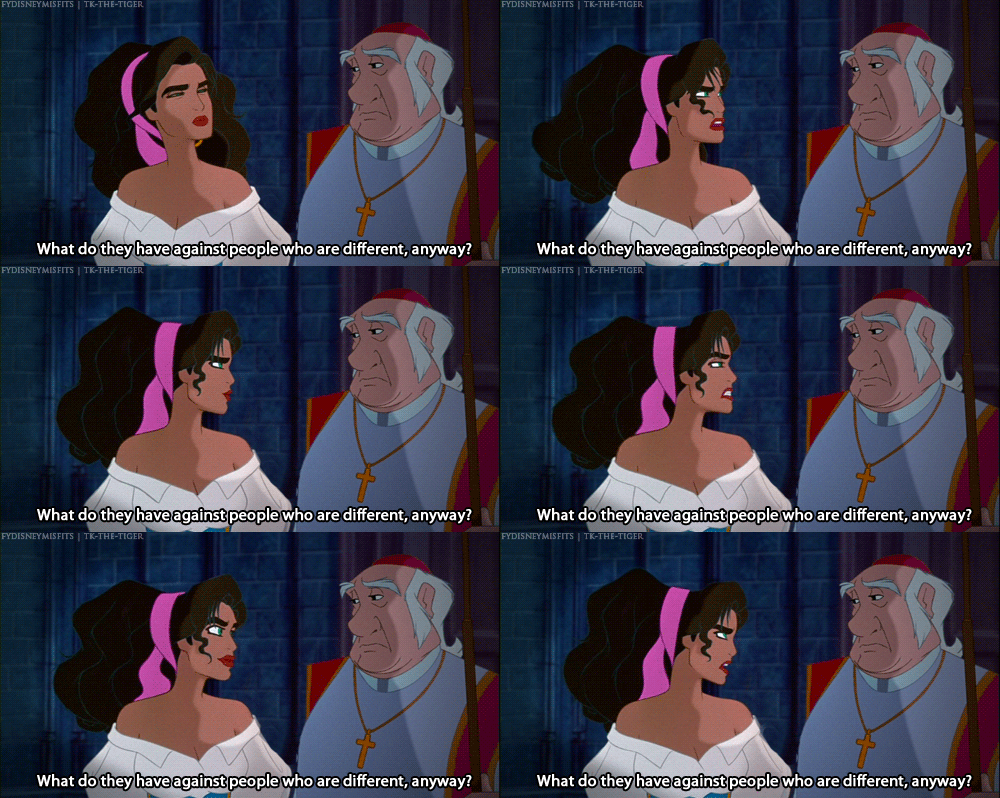
    In one particularly powerful moment, Frollo commands Esmeralda to be silent after she shows kindness to the bullied Quasimodo.
    "Justice!" she shouts back.
    Perhaps, we should all take a cue from Esmeralda. Perhaps, my fellow Christians should show kindness to the LGBTQ+ individuals instead of seeing them merely as sinners. Perhaps - especially to my fellow white American Christians - we should all support the Esmeraldas, the voices of the marginalized (religious, racial, sexual, gender, etc.) crying out for justice.
    "You speak of justice, yet you are cruel to those most in need of your help!" Esmeralda tells Frollo.  
    Perhaps we should not be the puritanical Frollo - or Pocahontas' racist Radcliffe or Beauty and the Beast's chauvinistic Gaston - silencing all who are different than the majority.
    Perhaps we should all endeavor to be like Disney protagonists once again. We should endeavor to see the inside of people different from us, to encourage the good, to subvert the system for love.
    This is what Disney taught me, and what I still faithfully cling to. This is the way of Jesus, who dined with tax collectors and prostitutes.
    This might be idealistic, but it is good.

    "God help the outcasts
    Hungry from birth.
    Show them the mercy
    They don't find on earth...
 
    God help the outcasts
    We look to You still.
    God help the outcasts,
    Or nobody will...

    God help the outcasts,
    Poor and down trod.
    I thought we all were
    Children of God."
    -Esmeralda, The Hunchback of Notre Dame

Love,
Kelley

Sunday, June 21, 2015

Pope Francis, Climate Change, and That Evil Liberal Scientific Agenda

    I have a confession: we scientists do have an agenda.
    It's learning.
    We like making discoveries. I'm a graduate student at MIT; of course I want to synthesize a cool new catalyst. Biologists want to discover the cure to cancer. Ecologists want to figure out a way to stop climate change, and neuroscientists want to understand how our brains work. Discoveries are our agenda.
    Moreover, in our private lives, I'm sure every one of us scientists has a social and political agenda. We're human, and we feel and believe things things as much as non-scientists.
    What we don't have is an agenda that mixes our evil liberal ideology with our science.
    Really. I promise.
    Science is mostly gathering and analyzing data. When neuroscientists discovered that transwomen brains function more like ciswomen brains, and that transmen brains function more like cismen, that's called data. Data is fact. The interpretation - that transgender is a legitimate identity and that people aren't lying when they say "this is how I am" - can be debated. The similarities found between transbrains and cisbrains, however, are not up for debate.
    Likewise, when ecologists and geologists discover that the earth's climate is changing, that's data. The cause and consequences may be debated, but you do not get to deny the data.
    So we can debate Pope Francis's encyclical all we want. We can disagree with his interpretation all day long.
    What we cannot do is deny the facts- climate change is real. And yet...
    So many conservative Christians - the community I hail from - do. Because scientists transform the magic and mystery of the world into facts, many Christians assume we are attacking religion, which is fundamentally associated with invisible, supernatural mysteries.
    Except, I'm a Christian myself. 33% of us scientists do believe in a god, and another 18% in some sort of higher power. So, while scientist may be less religious than other American populations, it's hardly accurate to say that science has an anti-religious agenda. 
    Basically, science is not a crutch to be twisted at will, as I was told earlier this week. The scientific method relies on skepticism and repetition and fact. Yes, there's interpretation, but typically we go with the simplest interpretation in accordance with Occam's Razor.
    So Pope Francis is not betraying the Christian faith when he says we are facing a climate crisis. He isn't siding with a liberal, anti-thiestic agenda. Rather, he has read and interpreted a deluge of scientific data as accurate, and decided that, as "the earth has been given to us" by God, we should care for it.
    Trust in science is not a betrayal of faith. It is not a political decision, or at least, it shouldn't be. Science is merely our attempt to discern facts about the natural world.
     Yes, we scientists are flawed and we will misinterpret and make mistakes, but that's why peer review and verification exists. No, the scientific method is not the be-all, end-all of reality, but few scientists would claim it is. Yes, we can, and perhaps should, be skeptical of scientists - and religious leaders and politicians, too!
    What we cannot do is dismiss people, whoever they are, as driven by an liberal, evil, anti-thiestic agenda just because it upsets our notions of how the universe works. We cannot deny facts just because they challenge us.
    Because then we're the ones motivated by a dangerous agenda - pride and trust in our own beliefs as fact, when all data contradicts us.

Love,
Kelley

Thursday, June 11, 2015

People Aren't Numbers: A Plea to Christianity Today

    Two days ago, leading Christian magazine Christianity Today published this article affirming their belief in one-man-one-woman marriage.
     Now, I truly believe that we must listen and learn from each other with humility and love. But I fear Mark Galli's article only serves to alienate - because despite his declared intention "treat with charity and respect those with whom we disagree," his article does nothing of the sort. Sweet words do not necessarily mean one is being respectful or charitable.
      First, despite the title, Galli cites no stats to back up his "2 Billion Christians" argument. This begs the question as to whether this estimate actually exists, or whether, once more, people's lives have been reduced to clickbait.
    Continuing with the title and lack of statistics, I really wonder how Galli intended the "Breaking News" part of the title as anything other than mockery. Again, that is neither respect nor charity. 
    Second, as I've argued before, we humans know so little about the universe and each other, that, when someone queer says "this is how I am, and God does not condemn me," perhaps it is best - the nonjudgmental, non-pharasaical way, in fact - to trust them, and let God handle the rest. To say that you know someone better than themselves is alienating, un-empathetic, and arrogant.
    Moreover, Galli claims that we who argue for LGBTQ+ inclusion are caving into culture. In this, he dismisses the work of Matthew Vines, my friend Derek, and any of the numerous scholarly Biblical interpretations that dispute Galli's opinion. 
    And, speaking of ostracism, Galli dismisses the suffering of the entire LGBTQ+ community in his implication that culture makes it easy to be queer. For many queer folk, coming out may cause ridicule, beatings, the rejection of friends and families. Coming out as LGBTQ+ poses a lot of risks, and facing those risks for the sake of justice and truth is hardly "caving into culture."
    As a Christian, I'd also like to point out that it's not caving into culture when the culture you grew up in is non-affirming (Rachel Held Evans once wrote an article articulating this in greater detail, but I can't find the link). Personally, as a straight ciswoman who could have easily blended in with non-affirming people, I spoke up because I felt I could not remain silent while any human suffered. I spoke up in spite of my culture, not because of it. 
    But Galli's dismissal doesn't stop there, and reveals something fundamentally broken in his argument. Galli claims "The church has been and remains overwhelming united," a statement that dismisses the opposing viewpoint as nearly nonexistent, mere noise created by American culture. Such a claim implies that because the opposing viewpoint has the smaller number, because these people are the minority, their voices are ultimately insignificant. The statistic that 48% of LGBTQ+ Americans are actually Christian doesn't matter. Only the majority, the privileged, the powerful, matter. 
     What Galli misses is that ignoring the small numbers only works for mathematical estimates, not for real people. Jesus, the Jesus Galli and Christianity Today and I myself claim to serve, stuck up for the marginalized. He treated every person like they mattered. 
    Ignoring the small but growing number of LGBTQ+ and affirming Christians contributes to the ostracism of this precious community. Respect and charity this is not, despite Galli's intentions. I have no doubt that he intended his article to be exactly as he claimed.
    Yet the problem is that when we aren't willing to hope the best in each other, we aren't loving each other as Jesus did. 
    The problem is that when we focus on the majority, we affirm that power, not the hurting minority, is what actually mattes. We dehumanize the minority in favor of a numbers game. 
    That's hardly respect and charity, and I hope Galli and all the non-affirming staff of Christianity Today learns this ASAP. Because this is real life, and all life matters.
      
Love,
Kelley


Saturday, June 6, 2015

I'm Ashamed of My Christianity

   
    It's been another of those weeks. A week I haven't had since World Vision. A week I am revolted at the word "Christian."
    Because, what is the point of calling myself a Christian when "Christian" is synonymous with hate?
    The idea of Christianity is love, love so fierce it's gentle, love grown wild and nonsensical. God is love, the Scriptures say.
    But where do we draw the line between the thing and the idea?
    Because the thing itself, as John Pavolitz says, often looks like outrage over "a person changing their own body, than one assaulting another's." The thing itself looks like abandoning innocent children for what's viewed as another's sin. The thing itself looks like denial of science and truth, like refusal to listen to others for fear that they may corrupt good morals. The thing itself looks like the arrogance of "I'm right and you're wrong."
   We live in a world reeking of hate and injustice masquerading as good, and Christianity contributes to that more loudly than they alleviate it (I suppose I do still hope that around the quiet parts of the world most Christians do good instead of evil). How does it not eat away at us like fuming acid? How can we stand it?
   I am sick of living in a rape culture where women are continually sexualized and blamed for it.
   I'm sick of living in a country where patriotism is next to godliness, a country that advocates the worth of every human being while slaughtering precious people in war, while keeping its black citizens disadvantaged, while administering the death penalty.
   And, I'll repeat it, Christians support this.

   Yet: conservative evangelical and fundamentalist Christians are the people who saved my life. They spoke hope into my darkest moments. They are not terrible people, despite what liberals say.
   These are good people. My liberal friends, please understand, conservatives aren't cold-hearted. They have the best intentions.
   They see their response to Caitlyn Jenner as speaking righteousness, warning her about the truth of God before she dies and faces judgement and eternal hell.
   Yet, if you're a conservative Christian reading this, I beg you: putting righteousness ahead of love is not righteousness. There's no balance to be had between the two. They are one in God, correct? They are one.
   And love and righteousness does not look like condemning a community in which the average life span is a mere 35 years. Yeah. Thirty-freaking-five. Let that sink in. Aren't you horrified? So the widespread condemnation and hatred of the trans community actually sends people to an early death, which I think is the opposite of what you want.
    To liberals: again, conservative Christians see their response to the Duggars as showing mercy to a family whose private lives are invaded, as displaying the lavishness of God's grace and forgiveness to even a pedophile.
    Except, dear conservative Christians: grace, and certainly not the righteousness you insist on blasting Caitlyn Jenner with, does not look like covering up abuse because the perpetrators have the same political and social beliefs as you. As someone who has been abused (albeit not sexually), please never say or post anything that might even just seem diminishing of abuse, because it will cause pain. Be a decent person and say "no, Duggars, you were wrong and hypocritical. Doesn't mean you're evil or inherently bad, but you and your son did something absolutely horrendous." Then pray and advocate for the victims. Because the victims must always come first.
    Seriously, conservative Christians and liberal ones, you don't have to have the right political or social views to be a decent person. I know plenty of conservatives who are great people and great Christians, much better at both than me.
    Just please be consistent in the love you show. Show Caitlyn the grace you showed the Duggars, and the Duggars the righteousness you showed Caitlyn. You can't have one without the other.

   But now I have to get angry again.
   You know what? We excuse people who cover up child abuse, lambast a persecuted minority for coming out, and then gasp when people say they want nothing to do with Christianity.
    Like, really?
    I am not ashamed of the gospel, no. But I am ashamed of us claiming to know the gospel and then throwing it away to take political and social sides.
    We've done a grave wrong this week, my friends.
    I'm a hateful mess of anger and pride, yes. I can't say I'm better than any of us. I'm not, despite the insistence of my pride.
    But I can say that we need to repent. Like a broken record, I will repeat: diminishing the covering up of child abuse, heaping condemnation on a persecuted minority is never acceptable to people or, dare I say it, to God.
   I'm hardly the person to call for repentance. I'm ashamed of my Christianity as much as I am ashamed of calling myself a Christian these days. My bitter, hateful heart that claims to follow Jesus has no desire to extend forgiveness to you. My heart prefers to flip the middle finger and storm off into the sunset.
    We'll never learn if we hate each other. We'll never learn if we think we're the One True Christian and those liberals or conservatives are beneath us.*
    Perhaps, we can make peace. Perhaps we can still learn to make the world a better place. I believe it because I can't bear to not believe it.
    Can we take steps to be decent people together? Can we repent and seek the way of Jesus together? Please?

Love,
Kelley

*I do think it's dangerous to hold anti-LGBTQ views, anti-woman views, etc. I'm not saying I'll ever be cool with those beliefs or that I want to be, because I won't and I don't. I just think bold dialogue and loving relationships are how people change and learn and grow.